Cinecicleta

Cinecicleta (kind of “bike and cinema”, in English) is a pair of bikeaholic persons who love movies. Why is so special about the Cinecicleta project carried out by Isabel Segura and Carmelo López? Well, they spent two years bringing the magic of movies to remote, small villages in Africa. At their webpage (https://cinecicleta.wordpress.com), you can see a short video to get some idea of their laudable work no matter if you do not know Spanish or French.

They rode 18,000 km (more than 11,184 miles) and made 217 screenings on white blankets in their journey. Best of all, they did so thanks to a portable cinema that carried in a bicycle trailer. Furthermore, they taught local people how to use it, how to produce electricity just by pedaling. So simple, so powerful. As a result, children faces watching a movie for the first time encouraged Isabel and Carmelo to continue with the project.

What’s more, Javier Zabala directed a documentary about their adventure in Africa that was released in April 2019. The method they followed was at least curious. The two adventurers were given three cameras in order to film the ride. As they fulled hard disks with material, they sent them to Spain. Here, Javier did the post-production work. As a result, the TCM channel was so satisfied with the documentary that decided to show it.

When journalists asked the couple what was the first thought when remembering the journey, they did not hesitate in answering: Freedom. And then explained, freedom consists in being lord of one’s time, that is precisely the drug which stimulate to ride again.

Curious sign

As cities change towards a more human and sustainable perspective, governments include traffic regulations and special traffic signs like the following:

I took the photo in Pamplona, but you can see it in lots of cities. It means no entry streets except for bikes, which do can ride in the two ways. Of course, riders should put extra attention to the vehicles and people they come across when moving against car traffic. In fact, this sign is presented at the beginning of a pedestrian area in which vehicles different from bikes run like fire trucks, police cars, ambulances or delivery vans.

Separators

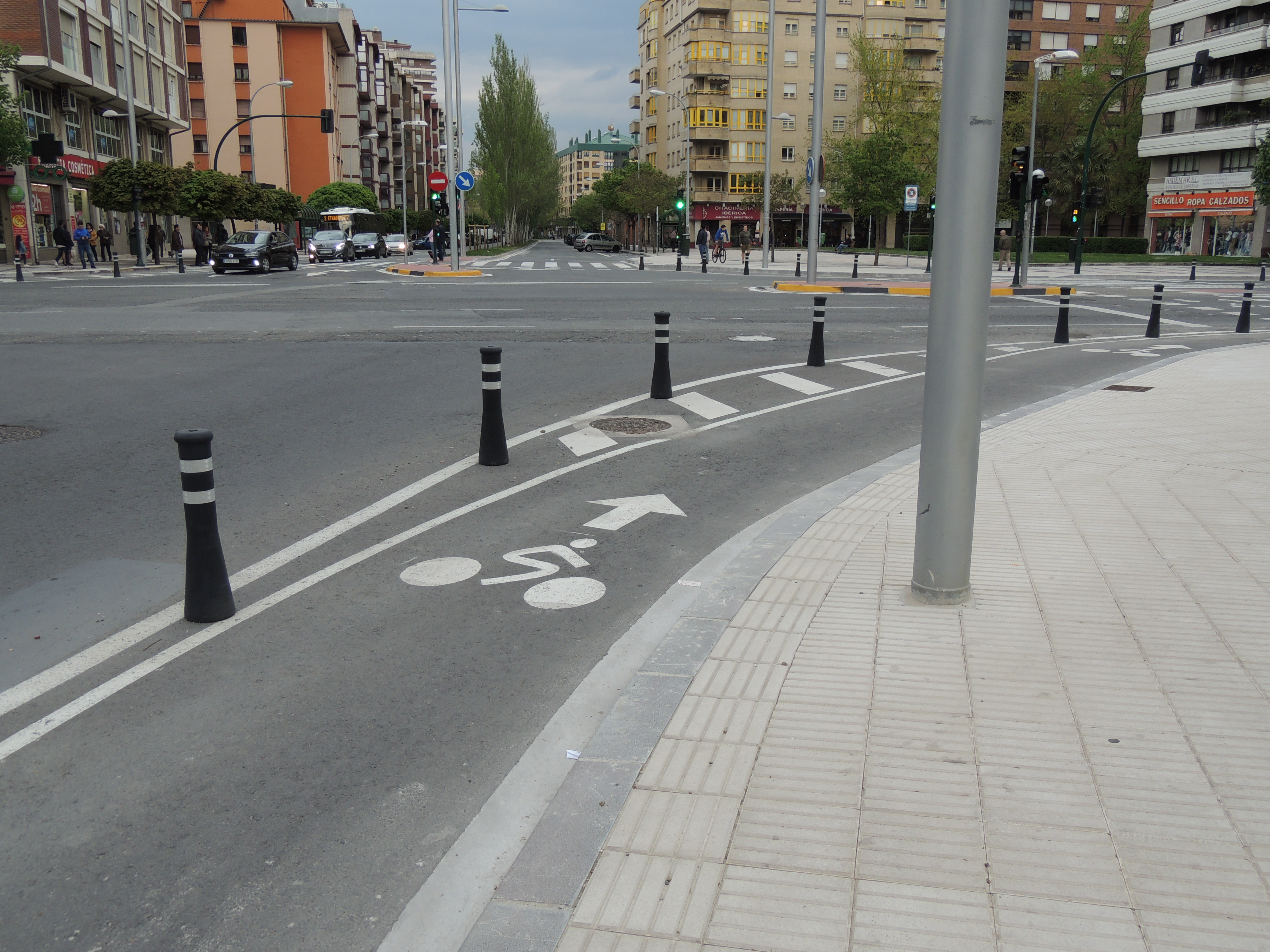
Separators in bike lines are needed in some complicated roads, specially those which suffer from excessive car traffic or in which cars circulate at illegal speeds. They constitute a safety element to protect cyclists and give a clear message to drivers: You must not cross this line. Easy and direct. There are a myriad of separators in urban biking ranging from different colors and shapes to incorporated issues. In the following example from Pamplona, they integrate reflective elements (the gray stripes) so that drivers see them even in a close night. The distance between two separators was not chosen so by chance. Technicians optimized it to avoid cars intrusion into the bike line and create the psychological effect like “do not trespass this line” in the driver mind. Besides, their height improves this point in contrast to the ground level separators which can go unnoticed by car drivers.

Pamplona bike line

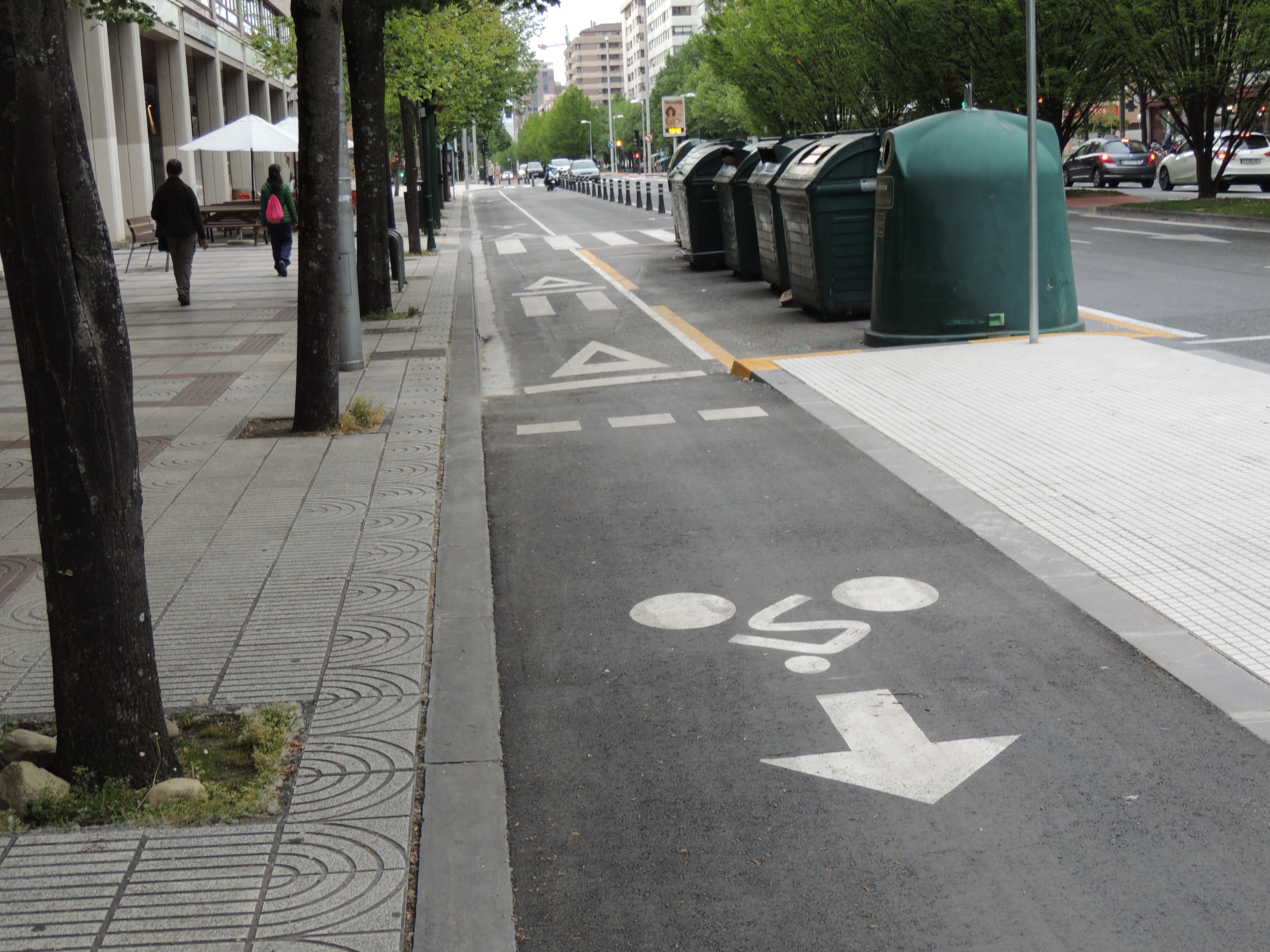
Pamplona is one of those cities in the north of Spain full of trees and vegetables thanks to the raining weather they enjoy. Pamplona is also a good place to ride. It has experienced a urban bike development in recent years, partially because of the new bike infrastructures. Here you can see one of these examples:

A bike line in an avenue is shown in the picture. It follows the exact sketch as the car lines, but additional elements are presented. Zebra crossings indicate bikers the pedestrian priority to cross the avenue, go to the trash cans or access the bus stop (the begging starts at the right of the image). Moreover, this effect is reinforced by the yield symbols. These double signals establish without any doubts who has right of way here. Furthermore, the arrow with the bike indicates the direction of travel. By the way, there is a second, one-way bike line opposite to the aforementioned one since this is a two-way avenue. Finally, beyond the trash cans, you can see an open surface which was a car line in the past. Thanks to the urban transformation, pedestrians gain space.

To sum up, intelligent bike infrastructures separate spaces for bikes, pedestrians and the rest of ways of transportation.

Seattle’s Bus Lanes

Bus only lanes in Seattle are used daily by cars because there’s no enforcement at all.
But bus riders had enough, so they decided to direct the traffic out of the bus lanes themselves

Provide flags so that other people do it

And since the politicians and the police won’t do it, the Seattle Department of Transportation decided to enforce it as well.

trafficnightmare.net

30 días en bici

30 días en bici is the Spanish campaign of 30 days of biking an international, one-month event for promoting the bicycle use. It consists in riding every day in the April month and taking photographs. Participants share images online. The American version, the pioneers, use the hashtag #30daysofbiking.

Founded in 2010, 30 days of biking started in Minneapolis, Minnesota. Its power lies in its simplicity. Bikers just need to pledge to bike everyday in April, no matter the weather (indoor photos are welcomed), and share their adventures. An easy and powerful idea as thousands follow it around the world.

Why 30 days? Rumor has it, one of its founders read a paper about developing a yoga habit by practicing it for 30 days. Then he asked himself if 30 days were enough to develop a habit, why do not we use it to promote the bike use? Again, easy and powerful.

Ok, but why April? April was chosen as the ideal month since is the first complete month in Spring and people love it after the Winter. Moreover, daylight hours increase (in the north hemisphere) and hence riding is increased at least for those who appreciate moderate temperatures.

The Spanish version has spread to more than 50 cities. It started in 2013 thanks to a bikeaholic group leaded by Carlos Rodriguez. But they do not limit the activities they do to April. Their ambitious targets tend to generate a social change by promoting the bicycle daily use, inspiring bikes as the main way of transport, educating citizens about the benefits of using the bike regarding health, and transforming cities in human-friendly spaces and caring for the planet.