Category Archives: Portland

Tilikum Crossing

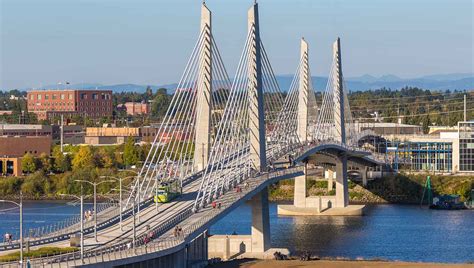
Back in September 2015 the Tilikum Crossing bridge was inaugurated in Portland, USA, to connect neighbors such as South Waterfront, Lair Hill or Brooklyn. This bridge was awarded as the Best Highway/Bridge by the magazine Engineering News-Record in 2016. Why is it so special?

The Tilikum Crossing bridge is a clear example of mobility for people. On the one hand, it allows public transport such as light trains like MAX, the tram Portland Streetcar, and buses such as FX2-Division, 9-Powell Blvd, 17-Holgate/Broadway or 19-Woodstock/Glisan. On the other hand, there are also two 4 meters wing sides to enjoy views over the Willamette river. This space is leveraged by bikes and pedestrians, so that every way of transport and person has its dedicated line. Cars, vans and trucks are prohibited.

This point not only ensures practically no noise, but also way less pollution. Not surprisingly, the local newspaper The Atlantic defined it as the bridge that banned cars. In contrast, the project promoter baptized it as the bridge for people. Indeed, a participatory process was carried out to select its name. Tilikum means people, community or relatives in Chinook Wawa (a historical contact language from the Pacific Northwest).
How useful are cargo bikes in natural disasters and wars?

The bicycle characteristics are ideal when natural disasters impact human livings. As I exposed when writing about bicycles after the DANA in Valencia (Spain), in 2024, bikes and above all cargo bikes are narrower than cars and transport first needed food to where is needed.

The concern about climate change, natural disasters and even wars has created initiates to share ideas regarding it. One example is the Kollapscamp in Wittstock (Germany). Contrary to what the name suggest, it is not a pessimistic camp for bikes. This event attracted 900 people to contribute to a platform to learn and share ideas about how bicycles can help overcome natural disasters and social crisis through workshops and talks. It also promoted strong, self sufficient communities without centralized nets, psychology, social organization and logistics.

Previously, as back as 2012, some tests have been done. For instance, the Disaster Relief Trials (DRT) in Portland (USA) consisted in bike cargo tests as a drill for using this type of bicycle to bring food aid to a catastrophic area. They evaluated how good are cargo bikes in transporting water or assisting in paths full of mackerel. They concluded that non-electric bikes are the best as the good management of energy is not needed in such scenarios.

The Tolocar project, promoted by the XYZ Cargo in Hamburg, has suggested to reinforce the supply routes with cargo bikes in Chernígov (Ukraine). XYZ proposes modular systems to adapt cargo bikes in few time.