The Women’s Ride on Queens Boulevard Takes Aim at NYC’s Cycling Gender Gap
Leave a reply
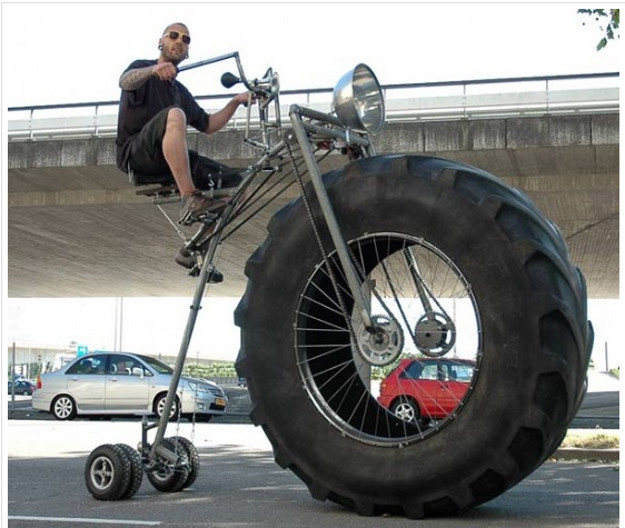
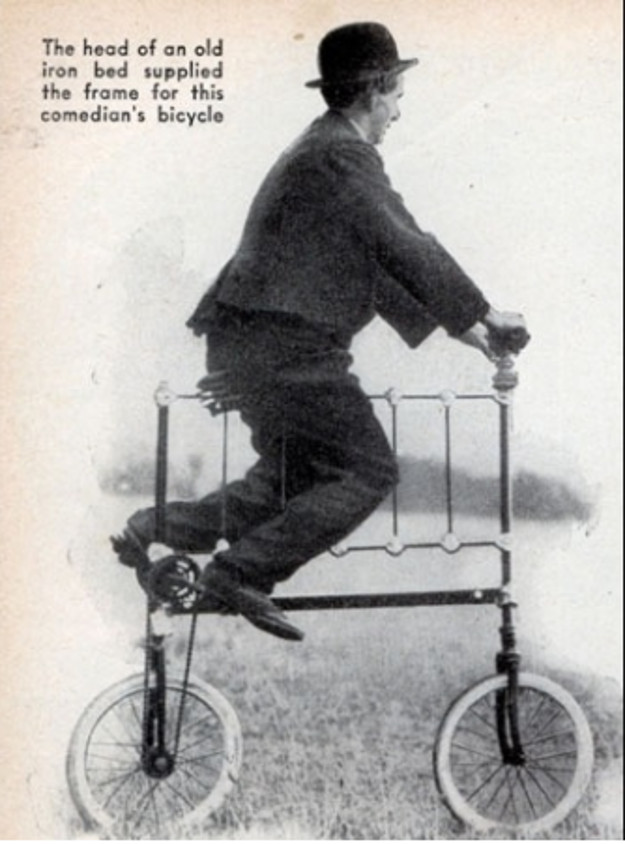
The term monster bike refers to constructions relatively similar to bicycles but different than ordinary bikes. A monster bike has more or less the same elements as theirs: chain, wheels, handlebars and so on. Some of them are modified on purpose just to show off or to create a sense of illusion or amusement when people see them. I wrote about the tall bike ridden by Quico and this is a kind of monster bike. One only needs imagination, the appropriate parts and perhaps a blowtorch in order to create monster bikes such as the following.
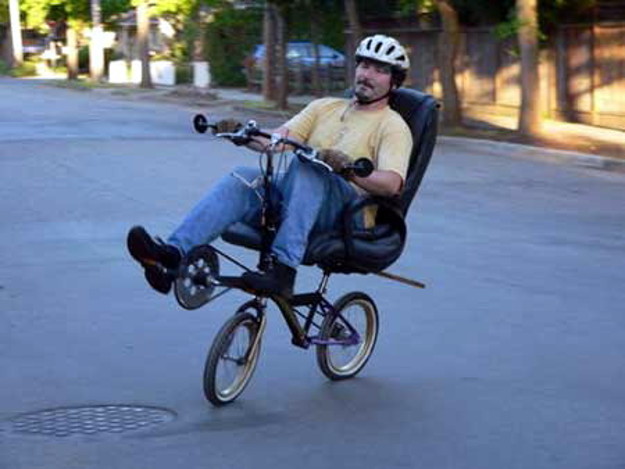

More elaborated monster bikes look like this:
The European Mobility Week started improving the sustainable movement in cities transportation. The European Commission created this event to give citizens alternatives to the use of cars in cities. Today, more than 2,312 cities from 48 countries follow this annual event and carry on with at least 551 mobility actions with the aim of promoting clean mobility. In addition, the European Mobility Week awards cities which have been doing a great effort to the path of sustainable mobility.
It also offers advices on how to cheer up green mobility in cities through European cities and beyond experiences in its Best Practice Guide in the 2017 edition. On the other hand, if you are a local authority, it is a good idea checking this handbook (http://www.mobilityweek.eu/fileadmin/user_upload/materials/participation_resources/2017/2017_EMW_Handbook.pdf), whereas if you want to organize a campaign or just want to be enlighten, have a look at the Thematic guidelines. The circle is closed as local authorities are encouraged to use it to test new transport measures and give back opinions from citizens. Local stakeholders can then discuss the different aspects of mobility and air quality, discover synergies and innovate solutions to reduce car-use and emissions, hence improving citizens health. Thus, actions aim at giving opportunities to pedestrians, cyclists and public transport.
For now, let’s see a practical example. During the 2017 European Mobility Week in Valencia, the city experienced a positive impact on green mobility. A specific magazine was edited with news and pieces of information. Among the activities, there was the Mobility Fair in the city hall square in which everybody could check alternatives to the more pollutant car mobility. On the Tuesday, the Children city was an event in which children were shown the surrounding of their schools and they symbolically penalize unsupportive, antisocial actions regarding mobility. This way, children are taught to recognize the positive actions instead of the harmful ones. Next, a workshop was done in which neighbors valued the urban public space and detected changing opportunity in order to improve the neighborhoods mobility. Moreover, engineers organized a meeting to discuss issues which linked mobility to road safety. Furthermore, the new app for the public bus system was presented. Besides, a film series and concerts were played each with focus on mobility. Finally, the Bike day took place in which more than 10,000 rode together to claim for the green mobility.
As I recently talked about, the XV Iberian Congress about urban biking is one of the most important events which will take place in Valencia the next May. The city will vibrate with this international meeting and the organization guarantees 5 days of intense, high-instructive, deep-learning experience. If you want to register for the activities, you have to fill in the congress page (only in Spanish at the moment I write this post).
What about the activities? All the five days will be plenty of activities. On the 16th May a riding on Valencia will happen and Morten Kabell, Copenhagenize General Manager, will open the congress with the speech Bicycle and city. From Thursday 17th to Saturday 20th May, an impressive amount of activities will take place in three different locations. Round tables, speeches, discussion boards and presentations will delight the attendees, and participants will shared ideas and connections. Mobilities and genre, politics, European funding regarding bike infrastructures, logistics, digital tools for sustainable mobility, how to evaluate the quality politics in the urban cycling design, social benefits, technical route in Valencia, the bike tourim development, bike and children, the Bike Equity net, mass media and bikes, the bike logistics evolution, health and mobility, intermodality, citizen sponsorship, working with bikes, air quality measuring, urban transformation and neighbor struggle, … are some themes which will be treated in these days. Routes and parties will also be enjoyed. The closing event will be carried out by Lake Sagaris.
IMPORTANT: Plan in advance after checking the congress program as most activities are determined in parallel. Thus, it is impossible to assist to all of it.
Moreover, the third Cyclist Women Meeting will be a reality on Saturday and Sunday. Women will enjoy several workshops from secure traffic to bike mechanics at all levels, and two ridings: BTT and road riding. All these events are exclusive for women, so men are forbidden here.
Finally, a riding in the vegetable garden, one of the treasures of Valencia, is planned on Sunday morning, whereas the Con bici (the supra Spanish association regarding urban biking) assembly will say good bye to these extremely, emotional, passionate, full of bikeholics and fun days, period.
Every year the Iberian Congress takes place in a different city. Vitoria-Gasteiz, Lisbon, Malaga, Vila-Nova de Gaia and Zaragoza organized it from 2012, and this years it is the turn to Valencia from the 16th to 20th May. This international congress encompasses projects and initiatives related to urban bicycle. The official slogan for this edition is Everybody counts towards the friendly city. The congress aims at supporting the cultural transformation towards the paradigm change which see the city in a new, healthy and sustainable way. It has four “friendly axis” as thematic blocks:
Two more events will take place in parallel to the Iberian Congress: The III Cyclist Women Meeting and the II Bicifest. The Cyclist Women Meeting will take place on 19th and 20th May. Its main purpose is to visibilise their needs, rights and spaces in society as it has coincided with the bicycle evolution through history, as well as reducing the gender gap.
On the other hand, the Bicifest (a local bicycle big event from 18th to 20th May) will consist in a lot of activities opened to the general public in order to bring the world of cycling to each of the city corners and its metropolitan, ciclable area.
You will have more information in the coming future.
The seventh edition of the Bicycle World Forum is going to take place at Lima (Peru) from 22nd to 26th of February this year. This key event for urban cyclist is the highest in the world and citizens, associations, international nets of bike-activisms, researchers, politicians and managers are welcomed. Indeed, it is the ideal place for everybody interested in cities, urban planning, public space use and bikes as part of the sustainable mobility.
The Bicycle World Forum fosters reflection and thoughts about mobility, citizenship, planning, access for everybody, public space and sustainability with the goal to positively impact the destiny of our cities.
The event will count with several activities:
For more info, check www.fmb7.org

Every two years the equip Copenhagenize Design Co. makes a raking with the top 20 bicycle friendly cities. Each city is given a score according to 14 parameters which try to collect the most important issues regarding bikes and cities in an unbiased way. This index has a lot of prestige. The parameters are:
The fact of using these parameters rather than asking individuals allows avoiding personal perceptions which prevents excessive positive or negative emotions. If that would happen, it would discredit the index in turns.
Although most of the cities in the ranking are European ones, the authors also consider cities from all the continents. In the 2017 edition, 136 cities in total were examine.
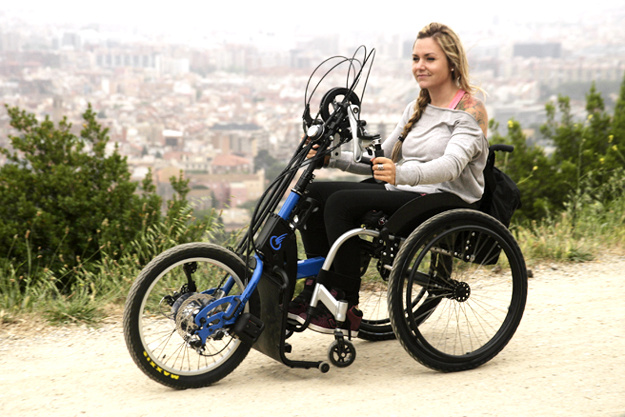
Have you ever thought whether or not a disabled person can ride a bike? And if so, how would they do it? People in wheel chairs have it easy. The handbike or handcycle is a special vehicle in which a component is hooked to the wheel chair to form machine with three wheels in total. It moves by the force of the arms. Basically, it uses the same mechanism as a bicycle, but allows users to move further than just using a wheel chair. Nevertheless and for safety, streets and paths must be adapted similarly as it was a wheel chair. This new experience makes users enjoy all the bicycles benefits such as sport, environment, happiness and so on. Indeed, there are groups which cooperate to benefit themselves. One of them is the Club Tres Rodes Aspaym in Valencia (Three Wheels Group in English), the first in Spain. They enjoy their handbikes, promote social inclusion, prepare routes once a month, participate in activities and defend its reason. They are inspiring leaders.
As the bicycle has been using more and more in the last years, drivers from the privileged group (car drivers) have been get used to it. Nevertheless, there is still a number of them who believes the whole street is for them. Sometimes cars do not respect bike or pedestrian lines, putting lives in risk. If only they would realize the potential damage their machines can cause. Moving a one-tonne car at 50 km/h (30 mph) or more is likely to produce death to a pedestrian in a car accident. Protests have been producing around the world from violent to peaceful ones. Between these lasts, the use of stickers is popular from Russia to Mexico. In the next video you can see how it works and the car drivers reactions.
A World Bike Forum (WBF) is a yearly event in which most of the issue related to urban cycling and mobility are discussed. One can find planning of cities, innovative actions on bike infrastructure or the main tendencies in urban cycling. It started in 2011 as a result of the tragic collision first anniversary. On the eve of the Critical Mass in Porto Alegre, a mad driver deliberately collided with around 20 cyclists on February 25. The next year, the first edition of the World Forum took place in the very same city. The Brazilian city repeated as WBF host city the next year. In 2014, another Brazilian city organised it. Then, it moved to Medellin (Colombia) in 2015 and Santiago (Chile) in 2016. This year Mexico city will be the city host of the WBF.
Among all, the best way to define it is freedom. The key principles are:
– Freeness: All the activities in the Forum are free
– Horizontally: The organizing work is done by volunteers, all the information is public and only flat organisation is allowed
– Most of the activities are self managed
– It is done by people for people, hence no publicity, logos or trademarked brands are allowed
The event will take place in Mexico in April 19th-23th 2017. It is so important that even the United Nations has cover its press conference launching (http://webtv.un.org/watch/launch-of-the-sixth-world-bike-forum-in-2017-in-mexico-city-press-conference-habitat-iii/5176866406001?page=1). You can’t miss it!