Paint Allergy

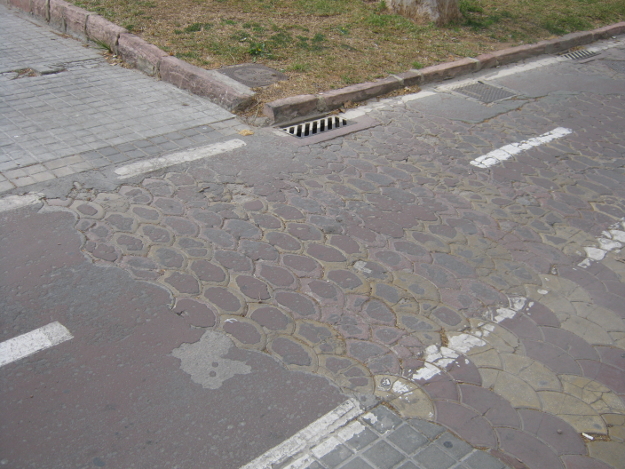
Strange as it sounds, I often see people driving in the middle of a two way road. They can easily cause an accident, but they aren’t drunk or high. So what’s happening?. Simply put, the white lines that guide us in our journeys are not there, and this is often found around the city.

And the crazier thing is that in order to solve this issue all we need is some paint, to make sure our roads look like roads, instead of minimalist abstract paintings.

paintAllergy

The 5 minute super-tuneup

Do you want to stop sweating while biking, avoid your chain getting stuck and bike nice and easy? Then you need the 5 minute super-tuneup!.

All you need is an air pump and bicycle chain lubricant, and here is how it goes:

  1. Pump air into your wheels until they’re 5-15psi bellow the maximum, which you can find written on your tires.
  2. On your handlebar, use the brake barrel adjuster to make sure your brakes work flawlessly (specially if you’re bound to bike in the rain). Tighten the adjuster locking ring after you’re done.
  3. Also on your handlebar, find your derailleur adjusters and, little by little, play with them until there’s no friction between your chain and the derailleur itself.
  4. Slightly lubricate your chain and let it dry for an hour or two.

Depending on how often you bike you, may want to do the 5 minute super-tuneup once or twice a month. Trust me, it’s really worth it! And if you want to know more, check this bicycle maintenance wikibook.

Green is the wrong orange

greenIsTheWrongOrange1

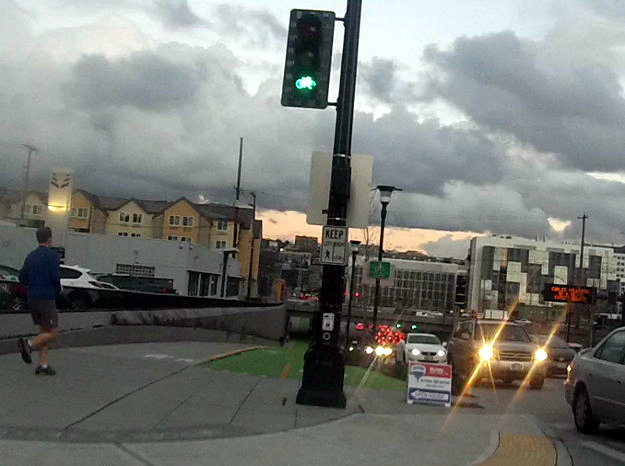
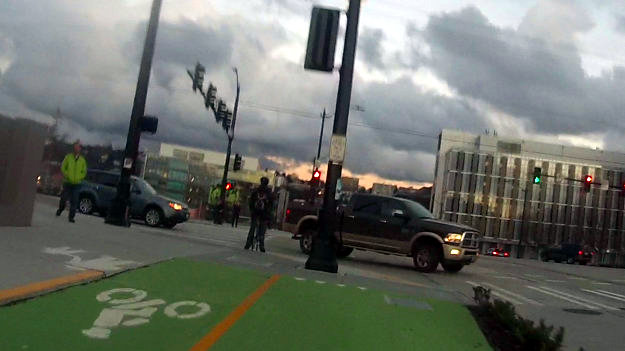
Every couple of days I witness a biker or a walker on the brink of being run over by a car. How come?: Seattle’s orange traffic lights are green!.

Incredible as it sounds, Seattle gives green lights to cars turning into crosswalks which have a green light too, resulting in a very dangerous situation that could be solved easily by making sure cars are given an orange light when turning into crosswalks with a green one, like the rest of the civilized world does.

This is a simple fix that requires no additional infrastructure, so please, Seattle, fix it!.

greenIsTheWrongOrange2

faltantornillos.net

Biking and health

Biking is considered a valuable sport since it protects your heart. This aerobic way of moving improves your health because it helps oxygenated blood to be pumped by the heart to deliver oxygen to the working muscles, mainly those in your lower part in your body. For this reason it forms part of the “cardio-sports” which improve your cardiovascular fitness. Another characteristic is that it benefices your muscle formation and toning. Also, by practicing it regularly your life-years are increased (wow!) (http://www.ncbi.nlm.nih.gov/pmc/?term=10.1289/ehp.0901747) as well as you better your mental health (http://www.ncbi.nlm.nih.gov/pubmed/17314466?ordinalpos=2&itool=EntrezSystem2.PEntrez.Pubmed.Pubmed_ResultsPanel.Pubmed_RVDocSum) and your immune system (http://familyonbikes.org/blog/2011/06/the-health-benefits-of-cycling/). Moreover, you coordination improves as your are constantly moving both your legs and your hands. There is no need to spent hours and hours on the bike to feel its benefices, just a few minutes. Nevertheless, aerobic exercises such as biking can become anaerobic if performed at a too high intensity level.

How not to build a bike line

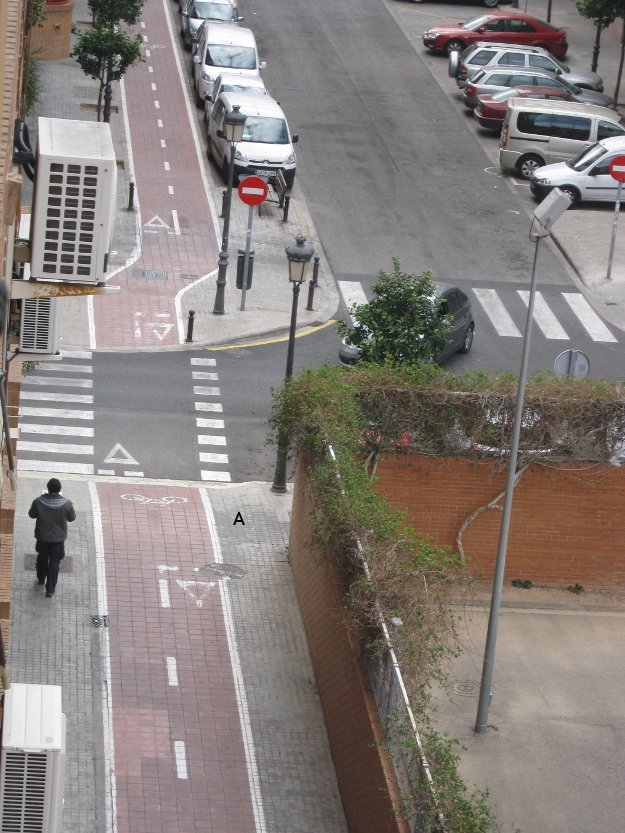
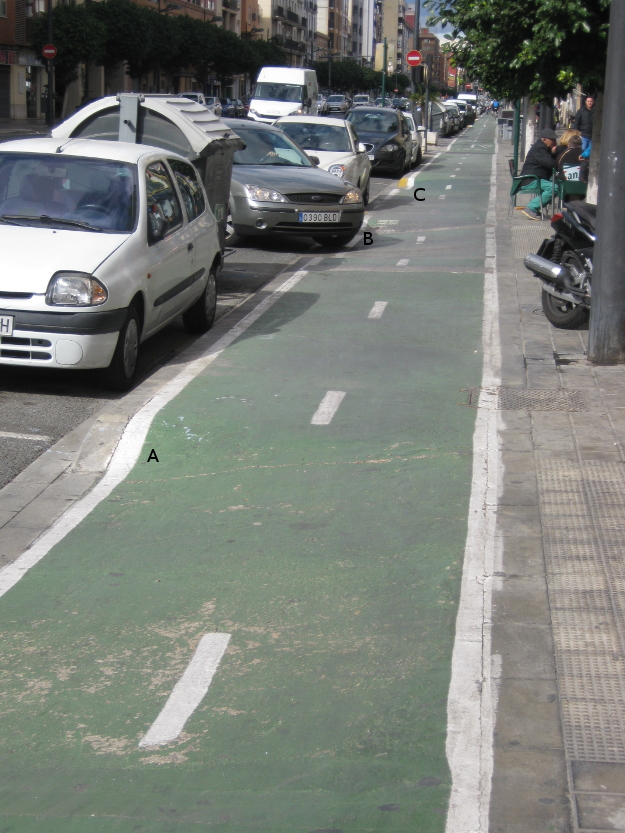
Bike lines constitute an easy and visible way to put on a brave face regarding green politics. This is clearly how non- or little-cyclist believe it. In real life, it is far more complicated. Bike lines produce a false feeling of security while riding, specially when it is shared with pedestrians. Accidents are produced by distractions or by their bad locations. For example, look at the point A in the next photo.

1

The fact of the small distance between the bike line and the wall, makes it perfectly possible to suffer an accident. This idea is reinforced if you take into account that the building at the right is a school and children run freely in working days.

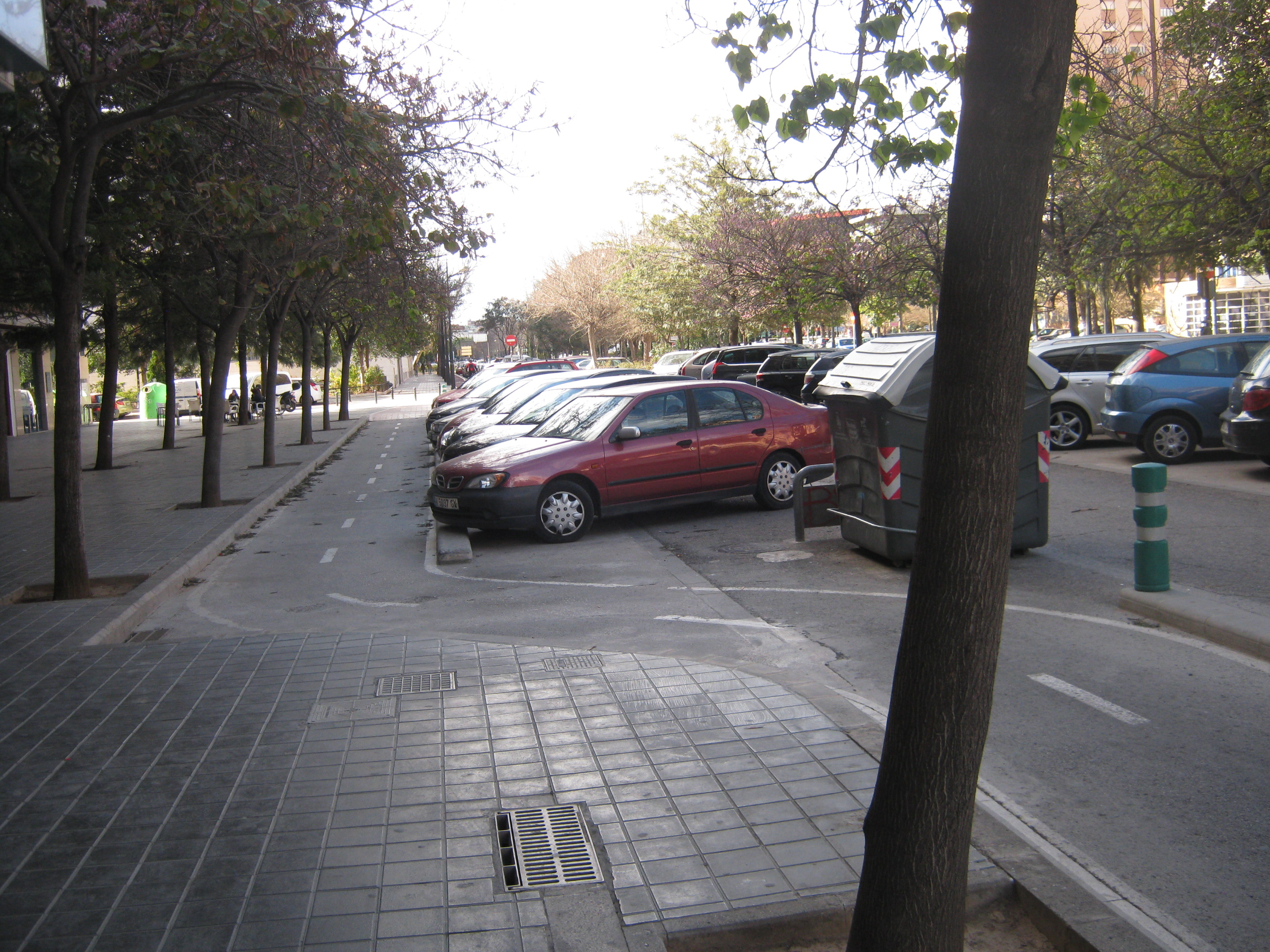
Sometimes bike lines are given in to cars. In photo number 2, the bike line curves in an almost chaotic way in order to respect the parking car. Again, most cities are proned to cars, not to people.

2

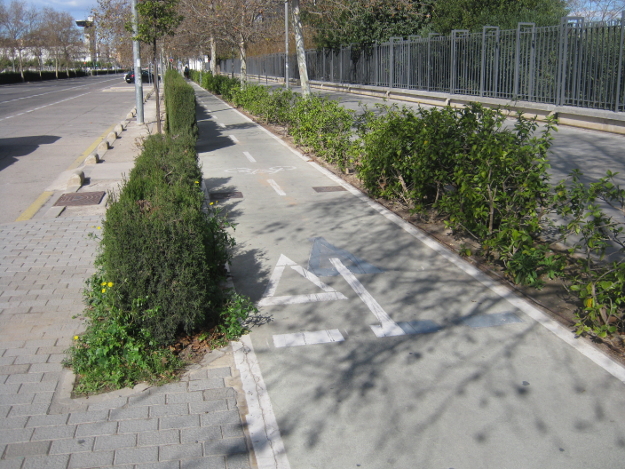
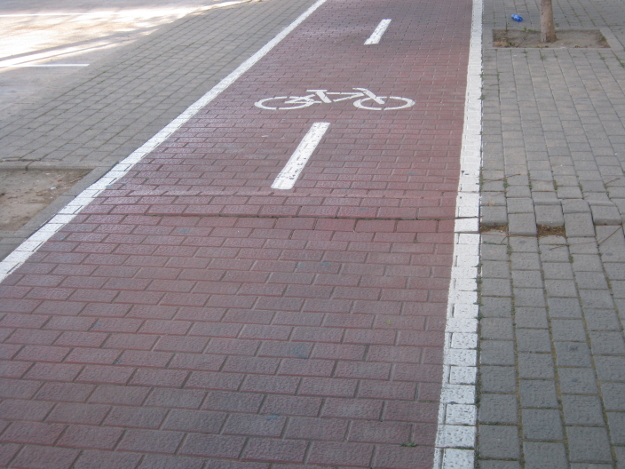
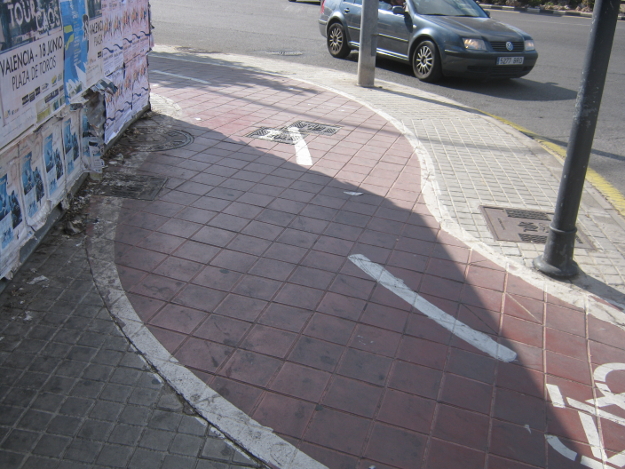
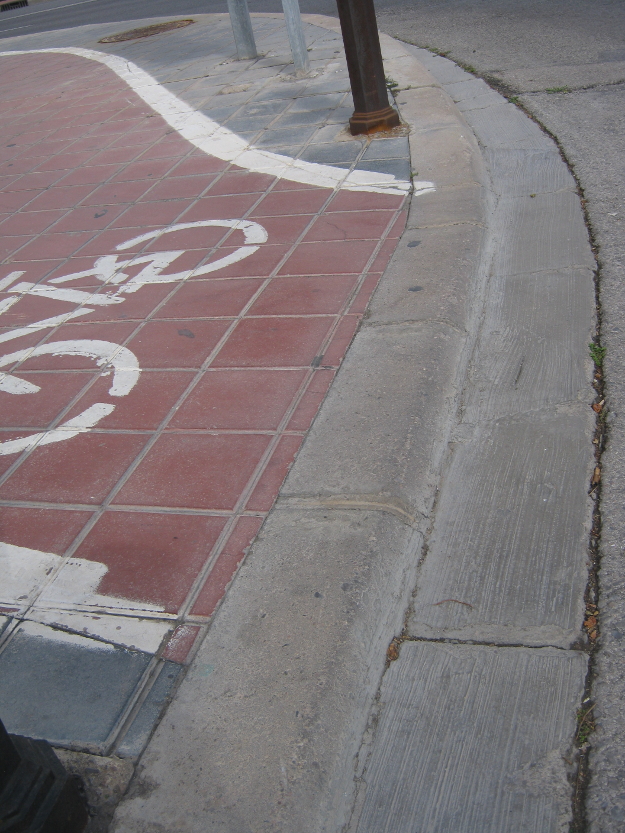
Few times bike line colors confound cyclists, like in the case of photos 3 and 4, both corresponding to the same avenue and different pavements. Here, red and green are used instead of define a homogeneous color.

3 4

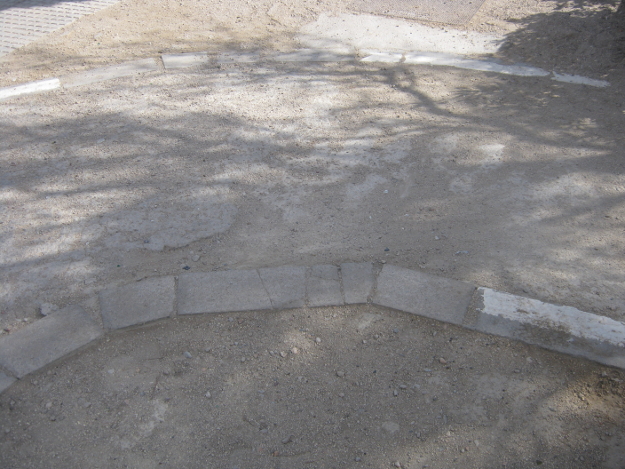
Photo 4 also shows obstacles and potholes make riding difficult. Constructing a bike line is much more than just painting lines in the pavement. Maintenance is needed and cases like photos 5 and 6 should be avoided.

5 6

Absurdities like photo 7 can make us thinking in another reason why bike line should be on highways, not on pavements. Here, people and bikes are virtually incompatible.

7

Moreover, curbs should be considered to facilitate an easy riding and avoid unnecessary jumps such as those in photo 8.

8

Finally, if you want a free ticket to the roller coaster, just ride in the photo 9, where there are three ups-and-downs to access to car parkings corresponding to points A, B and C.

9

San Francisco’s Critical Mass

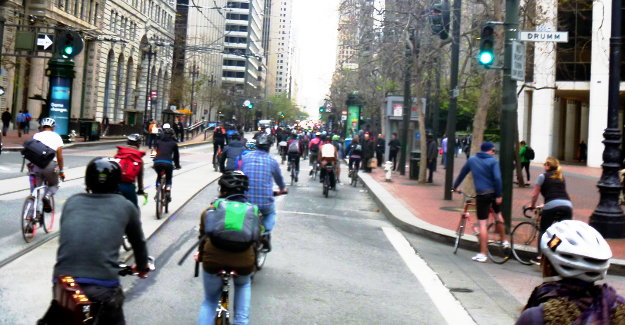
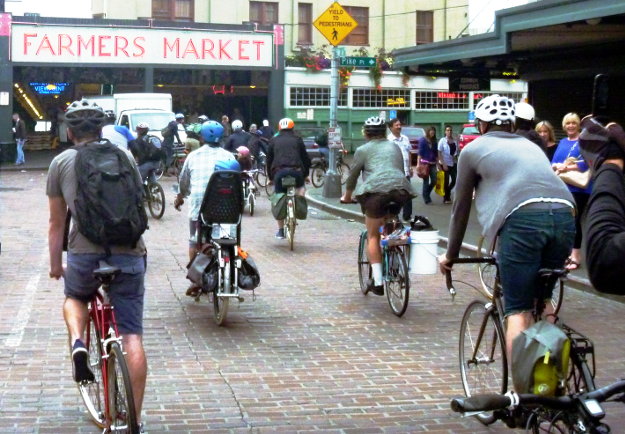
I’ve only done it once, but it was a blast!. San Francisco’s Critical Mass begins at 5:30 on Justin Herman Plaza. There are hundreds of bikers dressed both formally and informally, and is escorted by the police for courtesy and security.

The environment is quite festive, I remember bikes covered with flowers, bubble making machines mounted on cars, music, bikes that look like a harley davidson, etc. Plus people kindly stop cars and make sure the mass is dense and gap less.

The ride itself is nice and slow, allowing for people of all ages to enjoy it while also paying a visit to SF’s interesting spots. Additionally, the hills and the dusk light makes for great pictures, not to mention visiting the seaside and the Palace of Fine Arts at night.

sfCriticalMass

faltantornillos.net

Seattle’s Critical Mass

Seattle’s Critical Mass beings at 5:30ish at the Westlake Center. There, bikers socialize and, little by little, we ride in a big circle while also ringing our bells. At some random point, when most have joined, we depart without a planned destination.

Seattle’s Critical Mass always happens, rain or shine, although attendance greatly depends on the weather, ranging from tens to about a hundred. During these rides we try not to go through steep hills but sometimes there isn’t a more suitable options (or things are too chaotic to avoid them).

Still, you always get to meet people and discover interesting parts of the city. During my first Seattle’s Critical Mass I ended up on a birthday party on the other side of the city at 3am, but in other occasions we ended up riding around the International Fountain, visiting a p-path on the top of a building, and so on.

seattlesCriticalMass

faltantornillos.net

Bikes vs cars?

There are two basic ways to cross a city on a bike. On the one hand, there is the officially preferred path which consists on a bike line commonly designed by non-cyclist technicians (we will deep in this issue in the future). On the other hand, some bikers are prone to share the pavement with cars without physical barriers.

This last point has to do with the lack of secure alternatives within the cities and it’s likely to create a clash between the long-time favored, polluter motor vehicles versus the green model of sustainable transport on a broad scale, although bikes have been with us for ages. This is precisely one of the fears of compulsive car drivers: losing privileges in favor of bicycles.

What they do not see is that the more bikes in the streets, the better air we breath, not to mention the cuts in car accidents and their gravity, or the reduction in oil dependency among others. One of the easy-measured key indicators in the bad relation between cars and bikes is the number of horn hokes you hear when riding in a highway. Drivers who are aware of this issue respect cyclists as they feel us as part of the community and they could also be bikers themselves on the weekends. This synergistic model is what a lot of local governments are looking for. But dozens of years allowing everything car-related (including alarming dead figures in car accidents) is making this ideal coexistence tough. Nevertheless, important steps are being made towards the development of the bike movement and we thank them as part of the search of a better future.

Healing wounds

During the 50s and the 60s things where wrong, really wrong, when it comes to transportation diversity. The car filled the gap of the American dream: a big house on the suburbs and a work downtown required a way of transportation suitable for very low density in an individualistic society. Long and wide roads were built, and enormous wounds in the form of highways divided entire cities.

Most people here in Seattle love Vancouver, Canada. People mention how beautiful and nice it feels and here is one key thing: it isn’t crossed by a highway in the way most American cities are. Having a highway-divided city has one potential advantage: fast commuting. However, every single day its capacity is exceeded and urban highways are full and slow at peak hour and when there is a big event. Moreover, the properties around it loose value since nobody wants to live next to a source of pollution and noise. Not to mention the fact that, if you have a business and you aren’t a big brand, nobody driving on a highway is going to see you and take a detour to stop by.

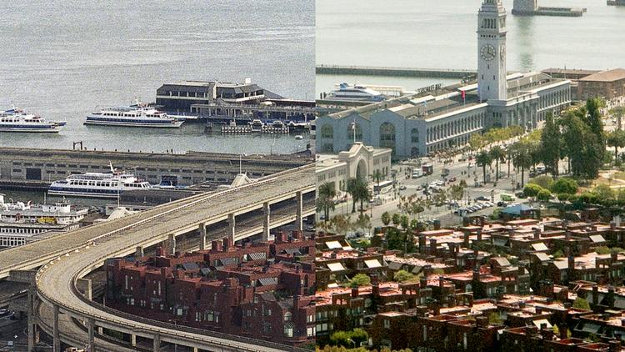
Luckily, though, the US has been healing these wounds. A clear example is San Francisco’s embarcadero area. Previously a noisy double decker freeway, the 1989 earthquake helped transform it into a beautiful open space that attracts a lot of tourists and locals.

embarcadero

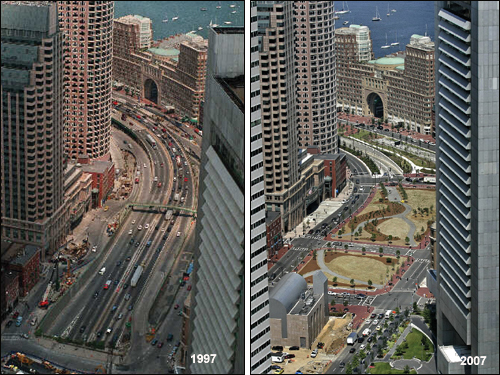
A similar thing could be said about Boston’s Big Dig which, despite having some issues, managed to substitute a high density highway with a more pleasant open space and nature

bigDig

And it isn’t only roads, Chicago’s Millennium Park turned a bunch of railroads into one of the most popular spots in the city. And Barcelona’s railways were rebuild underground to improved the whole city.

And now, Seattle, what are you waiting for?.

faltantornillos.net