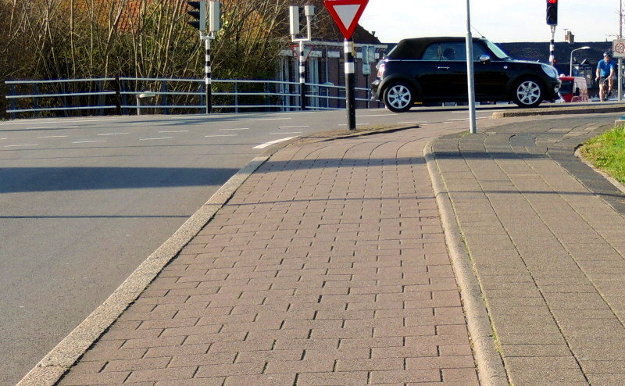
If there aren’t roads like this:
Why are there bike ways like these?:
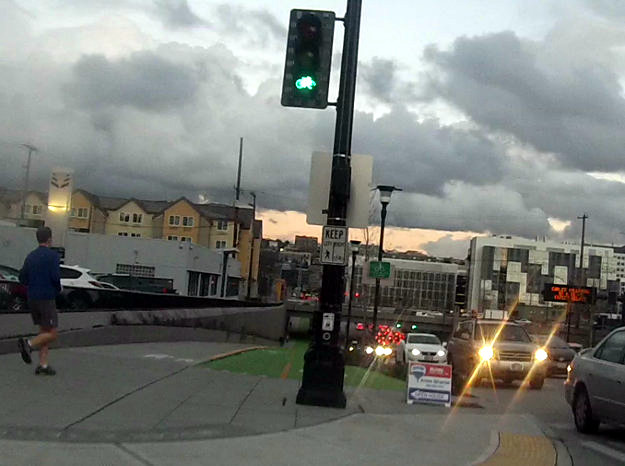
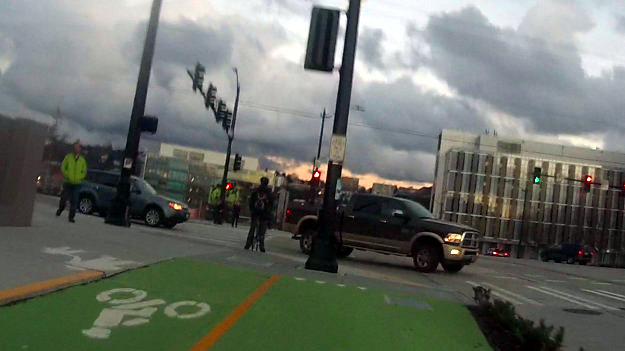
Seattle’s Critical Mass beings at 5:30ish at the Westlake Center. There, bikers socialize and, little by little, we ride in a big circle while also ringing our bells. At some random point, when most have joined, we depart without a planned destination.
Seattle’s Critical Mass always happens, rain or shine, although attendance greatly depends on the weather, ranging from tens to about a hundred. During these rides we try not to go through steep hills but sometimes there isn’t a more suitable options (or things are too chaotic to avoid them).
Still, you always get to meet people and discover interesting parts of the city. During my first Seattle’s Critical Mass I ended up on a birthday party on the other side of the city at 3am, but in other occasions we ended up riding around the International Fountain, visiting a p-path on the top of a building, and so on.
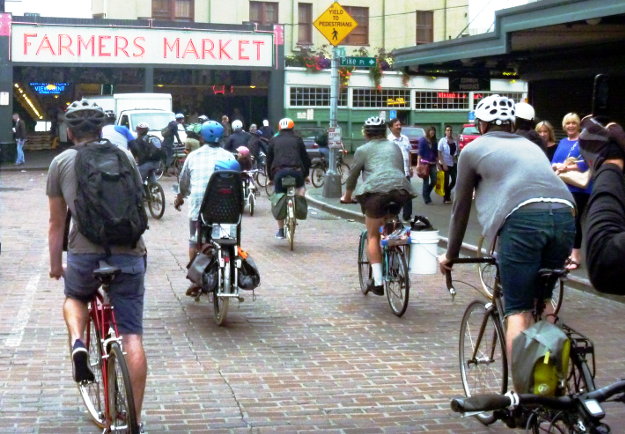
There are two basic ways to cross a city on a bike. On the one hand, there is the officially preferred path which consists on a bike line commonly designed by non-cyclist technicians (we will deep in this issue in the future). On the other hand, some bikers are prone to share the pavement with cars without physical barriers.
This last point has to do with the lack of secure alternatives within the cities and it’s likely to create a clash between the long-time favored, polluter motor vehicles versus the green model of sustainable transport on a broad scale, although bikes have been with us for ages. This is precisely one of the fears of compulsive car drivers: losing privileges in favor of bicycles.
What they do not see is that the more bikes in the streets, the better air we breath, not to mention the cuts in car accidents and their gravity, or the reduction in oil dependency among others. One of the easy-measured key indicators in the bad relation between cars and bikes is the number of horn hokes you hear when riding in a highway. Drivers who are aware of this issue respect cyclists as they feel us as part of the community and they could also be bikers themselves on the weekends. This synergistic model is what a lot of local governments are looking for. But dozens of years allowing everything car-related (including alarming dead figures in car accidents) is making this ideal coexistence tough. Nevertheless, important steps are being made towards the development of the bike movement and we thank them as part of the search of a better future.
During the 50s and the 60s things where wrong, really wrong, when it comes to transportation diversity. The car filled the gap of the American dream: a big house on the suburbs and a work downtown required a way of transportation suitable for very low density in an individualistic society. Long and wide roads were built, and enormous wounds in the form of highways divided entire cities.
Most people here in Seattle love Vancouver, Canada. People mention how beautiful and nice it feels and here is one key thing: it isn’t crossed by a highway in the way most American cities are. Having a highway-divided city has one potential advantage: fast commuting. However, every single day its capacity is exceeded and urban highways are full and slow at peak hour and when there is a big event. Moreover, the properties around it loose value since nobody wants to live next to a source of pollution and noise. Not to mention the fact that, if you have a business and you aren’t a big brand, nobody driving on a highway is going to see you and take a detour to stop by.
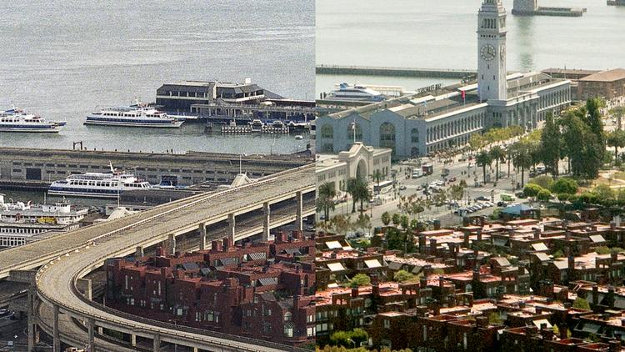
Luckily, though, the US has been healing these wounds. A clear example is San Francisco’s embarcadero area. Previously a noisy double decker freeway, the 1989 earthquake helped transform it into a beautiful open space that attracts a lot of tourists and locals.
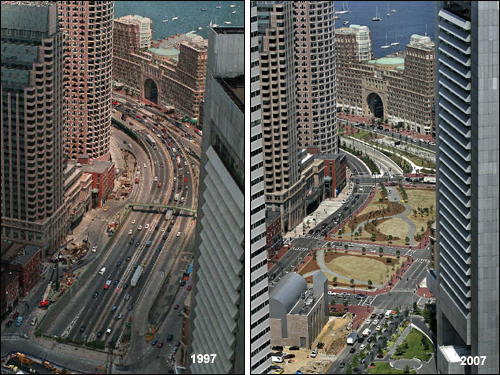
A similar thing could be said about Boston’s Big Dig which, despite having some issues, managed to substitute a high density highway with a more pleasant open space and nature
And it isn’t only roads, Chicago’s Millennium Park turned a bunch of railroads into one of the most popular spots in the city. And Barcelona’s railways were rebuild underground to improved the whole city.
And now, Seattle, what are you waiting for?.
I am going to talk about the Critical Mass in Valencia (Spain) today. It starts at the Virgin square in downtown the first Friday of every month at 19:30, no matter if it is raining, the wind blows, is a holiday or the sun shines. This fact as well as the climatic variations in the four seasons make that the number of participants varies along the year, reaching the highest figures in spring, summer and the first months of autumn.
It is particularly interesting that the Critical Mass has no direction, neither organizers. This way it can end in the same place where it starts, the beach, the former riverbed, close villages and so on.
Regarding the bikers, everyone can participate in this ride from children to senior citizens since the reached velocities allows to enjoy it without even sweating. Sometimes politicians come such as Giuseppe Grezzi, the current Mobility Advisor who is making efforts in favor of sustainable mobility. Moreover, one can see strange bicycles like the bike-monsters, the “bici-gelat” (a horchata truck bike, being horchata a typical Valencian tiger nut milk drink) or the odd boat-bike which swings as it was a true boat. People in handbikes and skaters are also welcomed. To contribute to the festive ambient, participants dress up like in carnival from time to time.
As far as logistics issues are concerned, police closes the Critical Mass to calm traffic almost every time. Indeed, bikers close themselves perpendicular streets to where it passes chatting to car drivers to pacify them because not each and every driver is a good one. What is more, the Spanish legislation is partly unknown, specifically the point which indicates that a group of cyclists is treated as a sole unit referred to zebra crossings, stops, traffic lights, traffic circles… One important point constitutes the fact that the bus line is respected as it represents a path of sustainability.
Finally, it ends with a huge applause and the ride is a success due to the collaboration of all people involved.
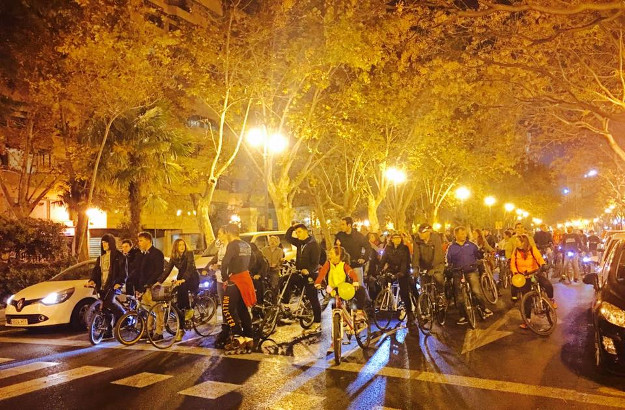
Foto by Antuan Toledo
Let me start by the beginning. The grounds appeared in China as a consequence of a characteristic cyclist behavior. It consists in a cyclist waiting in an intersection until a group of bikers is created. Once they have the sufficient power and visibility, they can cross it and force the cars to stop. By the way, the name of “critical mass” is taken from this film.
Then, it jumped up into the U.S. and specifically to San Francisco as the first “official” Critical Mass. Here, the participants had to fight against the lack of understanding of local authorities and dramatic actions were even taken. The documentary We are traffic! shows those initial moments. As you can see, the atmosphere was committed with all the participants wanting to spend a good time while at the same time they defended claims such as a better world, pollution reduction, practicing more sport, reducing street accidents and so on.
Today it is celebrated in more than 300 cities worldwide once a month. The specific date varies between places and it is a good idea to contact with local bikers to join it. So remember, if you see suddenly cyclists on the street, let’s say dozens, hundreds or even thousands, you would be probably seeing the Critical Mass. It could also be possible that it did not still exist where you live. If this is the case, why don’t you start it?.
Something apparently so simple, yet so often made wrong. Bike ways are key when it comes to urban planning. And rather than building miles and miles for statistical purposes, one should consider them as the main point to make vulnerable users feel safe.
in order to do so there are a number of points to consider, here are some:
Biking in the Netherlands is like a dream: physically separated, perfectly paved bike ways take you all around and make you feel safe while on the road. Children, workers, and retirees commute by bike and they are promoting it more and more.
However, it wasn’t always like that. Back in the 50s and 60s most drove a car, older buildings were destroyed in order to make way for big avenues, pollution and accidents were on the rise.
So, how did they go from then to now?.
I’m sure there were a number of reasons for this radical change, but that first spark was the fact that society realized the number of accidents, dead people, and specially killed children was outrageous. And so they began campaigning: activists demonstrated and occupied in favor of life, everybody’s lives.
Eventually, they got funding in order to design safe urban planning. And they kept demonstrating and pushing towards an increase in bike facilities, lowering speed limits, and so on.
Not to mention the 1973 oil crisis, which multiplied the price of oil and made clear that transportation had to be diversified.
And so now, biking is an essential part of Dutch culture, and increasingly the whole world.