Nijmegen: Best dutch cycling city
Leave a reply
Every two years the equip Copenhagenize Design Co. makes a raking with the top 20 bicycle friendly cities. Each city is given a score according to 14 parameters which try to collect the most important issues regarding bikes and cities in an unbiased way. This index has a lot of prestige. The parameters are:
The fact of using these parameters rather than asking individuals allows avoiding personal perceptions which prevents excessive positive or negative emotions. If that would happen, it would discredit the index in turns.
Although most of the cities in the ranking are European ones, the authors also consider cities from all the continents. In the 2017 edition, 136 cities in total were examine.
A bicycle is much more than a machine for transportation. It has been used in a variety of ways since it was invented. The ancient prototypes were used mainly for sports and bourgeoisie entertainment, but bike history is much more than this. Today I am going to write about bikes and wars.
Bicycles were initially used back in the Franco-Prussian War (1870 – 71) when the French troops were the first to use them on the war field. Imagine how uncomfortable was ride high-wheel bikes on dirt roads and mud paths. Some 30 years after, the British experienced with the bicycles during the Anglo-Boer War (1899 – 1902) in South Africa. Contenders looked for mobility.
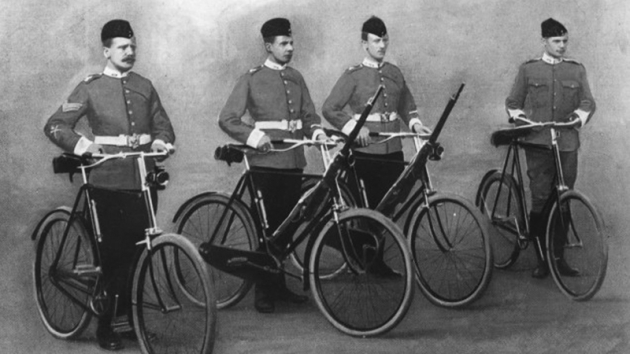
During the First World War, the Belgian, German, Italian, British and French armies used bikes with unequal success. The Italians were who most employed them. Their elite light infantry Bersaglieri regiments made used of them in order to improve mobile tactics and flashy incursions. In addition, scouts and messengers were among the top bicycle users. Soldiers could attach rifles down the tube or swung across their back. The British bikes were manufactured by Birmingham Small Arms Company which was a major British arms and ammunition producer since the Crimean War (1854 – 1856). Millions died in the Great War and among the casualties were 15 cyclists who rode in the Tour de France in 1914.

Bicycles were used again in the Second World War. British and American paratroopers realised bikes offer advantages for reconnaissance. On the other side, Japanese dealt with rubber shortages and rode the rims without tyres on rough jungle rails.

The bicycle simpleness made transportation quick and reliable. Even in 2008 the Australian Military used it in East Timor to improve flexibility of field patrols. The unit was the Bicycle Infantry Mounted Patrol.
The problem with such tall heights was the instability. Thus, it was used for sport rather than as usual way of transport. Manufacturers homogenised the bicycles by standardising the front wheel to the 1.2 m diameter and the rear wheel to 40 cm.
The word bicycle was common in the UK in 1880. The French translated it as bicyclette. The use of rubber tyres instead of wood was introduced by John Boyd Dunlop in 1888 making the rides more comfortable. At the same years, the French brothers Michelin created a removable tyre and so did the Italian Battista Pirelli.
The bicycles weighted between 18 and 20 kg in these years. The brake pads appeared in 1893. The invention which allowed to think the bicycle as a mass vehicle was the chain transmission between chainring and sprocket. This new incorporation was developed by the French Guilment and the British Harry John Lawson in 1879 although its production took place in 1884. In the same era the bicycle with chain transmission and equal wheels appeared thanks to John Kemp Starley. This bike was commonly known as Rover Safety Bicycle. This was the precursor model of the modern bicycle.
The bikes we enjoy nowadays are evolved from the 1885 Rover bicycle. Starley should be considered the father of the modern bikes production as he started it in his company The Rover Company, co-founded with William Sutton, in 1877. They banged them out and it was well accepted in every country. In the XX century, only small improvements have been made to the bicycle such as the gear change or the use of lighter and more resistant materials.