Cargo bikes

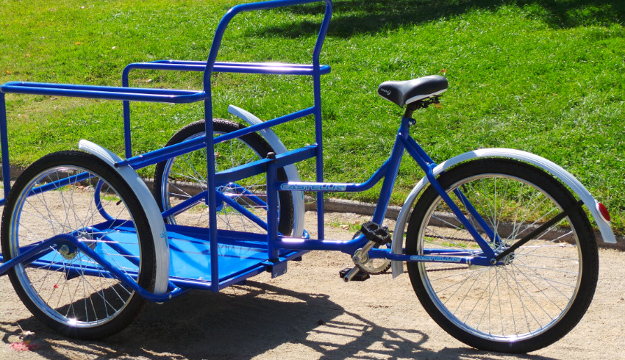
I know we have already talked about cargo bikes. I also know the use of this kind of bikes will increase in the coming years as a result of optimizing deliveries in cities. Laws will restrict the use of cars and vans to deliver goods specially in downtown areas. In addition, both environmental and economic costs reduction will make it essential. Moreover, the reduction of noises is appreciated by neighbors. What is not always well known is the high diversity in cargo bikes.

In the picture bellow, one can see a variety of them. Some can carry objects in the rear, whereas some others can do it in the front. Furthermore, some cargo bikes allow to transport merchandises in the back as well as in the front. The fact of allowing removable elements makes them incredibly versatile. For those companies specialized in deliveries, cargo bikes with fixed elements constitute a good solution for the day-to-day activities. Ideally there is a cargo bike for every need.

A damned curve

Shared streets between bikes and pedestrians are usually problematic. Distractions or lack of awareness are common causes for accidents. I talked about why bike-lines should not be on sidewalks without a physical barrier to make it clear on what part pedestrians walk and on what zone bicycles should ride. The height of hypocrisy is highlighted in situations like this:


On the photo one can see a shared sidewalk (blue signal) which is itself a potential cause of accident and the awful route with the corner with no visibility whatsoever. If this was a street only for pedestrians or in other words bikes do not ride on it, it would be right. But the moment somebody decided bikes should invade this space, a potential chaos can be done. In addition, the avenue next to it has four car lines for each direction. The solution here would be creating a bike-line by transforming one car line. This way every actor in the scene (pedestrians, bikes and cars) would have its own space physically separated so that accidents would be virtually zero.

Cochistas

The word cochista does not exist in any Spanish dictionary. Perhaps there is an equivalent word in your mother tongue. It is a word which was made up to define a person who uses the car for everything from moving to another city to buy bread in the bakery at about two minutes walking. They believe themselves as the city owners and whatever change towards a more sustainable traffic is imposed in the streets by public institutions, causes a total, irrational rejection.

What these people does not understand, or not want to understand, is the reality. They fall for the automotive companies ads which equal cars to freedom. Quite the contrary, cars are prisons. The car owner is chained to fuel, taxes, insurances and so on. The evil impact is completed with the loss of health (pollution, disgusting noises, lack of exercise), environment (pollution and noises) and the waste of money. You know, the unique chain which frees is the bicycle one.

The European Mobility Week

The European Mobility Week started improving the sustainable movement in cities transportation. The European Commission created this event to give citizens alternatives to the use of cars in cities. Today, more than 2,312 cities from 48 countries follow this annual event and carry on with at least 551 mobility actions with the aim of promoting clean mobility. In addition, the European Mobility Week awards cities which have been doing a great effort to the path of sustainable mobility.

It also offers advices on how to cheer up green mobility in cities through European cities and beyond experiences in its Best Practice Guide in the 2017 edition. On the other hand, if you are a local authority, it is a good idea checking this handbook (http://www.mobilityweek.eu/fileadmin/user_upload/materials/participation_resources/2017/2017_EMW_Handbook.pdf), whereas if you want to organize a campaign or just want to be enlighten, have a look at the Thematic guidelines. The circle is closed as local authorities are encouraged to use it to test new transport measures and give back opinions from citizens. Local stakeholders can then discuss the different aspects of mobility and air quality, discover synergies and innovate solutions to reduce car-use and emissions, hence improving citizens health. Thus, actions aim at giving opportunities to pedestrians, cyclists and public transport.

For now, let’s see a practical example. During the 2017 European Mobility Week in Valencia, the city experienced a positive impact on green mobility. A specific magazine was edited with news and pieces of information. Among the activities, there was the Mobility Fair in the city hall square in which everybody could check alternatives to the more pollutant car mobility. On the Tuesday, the Children city was an event in which children were shown the surrounding of their schools and they symbolically penalize unsupportive, antisocial actions regarding mobility. This way, children are taught to recognize the positive actions instead of the harmful ones. Next, a workshop was done in which neighbors valued the urban public space and detected changing opportunity in order to improve the neighborhoods mobility. Moreover, engineers organized a meeting to discuss issues which linked mobility to road safety. Furthermore, the new app for the public bus system was presented. Besides, a film series and concerts were played each with focus on mobility. Finally, the Bike day took place in which more than 10,000 rode together to claim for the green mobility.