This Cyclist Took Back the Bike Lane on the Brooklyn Bridge
Leave a reply
The USA is possibly the most pro-car country since distances from A to B points are impressive and some of the more important car firms set up there. Moreover, car marketing is astonishing (similarly to every developed country in the world) and car industry has hundred of thousands of employees, hence this had some magnificent cities like Detroit in the past. Millions of cars are driven every day and thus it is huge when urban mobility is increased without taking into account car needs.
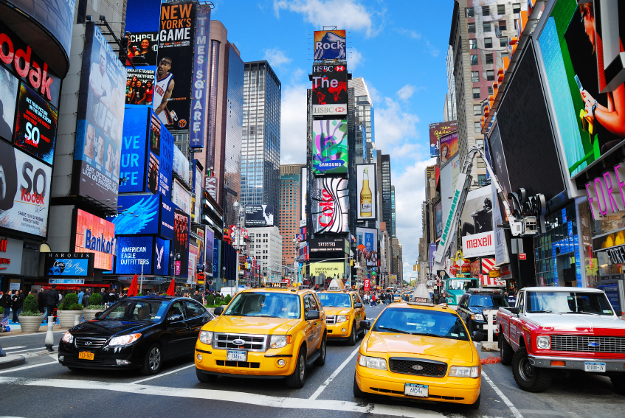
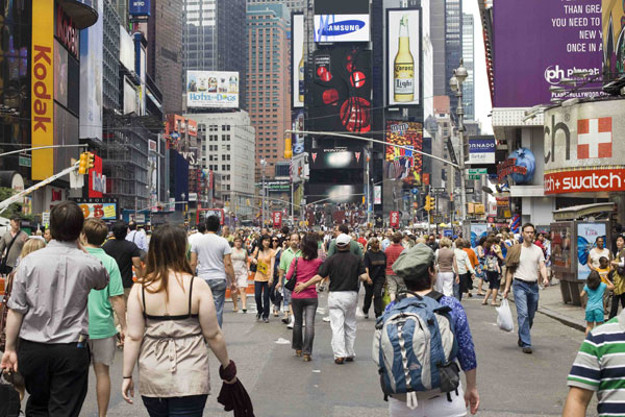
The case of Time Square (New York) is a good example. The pride it causes makes a lot of cities wanting something like it. In other words, giving more space to pedestrians and green vehicles such as bicycles is a worldwide tendency.
Just compare both images to see what happens when pedestrians can securely walk without the noise and pollution cars cause. It is like magic. Suddenly, people show up from all over and enjoy the area. If you consider the fact that Time Square is one of the top world areas with the highest stores per squared mile, you determine sales increased as a result of it. There are no two ways about it and figures confirm it. Pedestrians can walk and thus spend more time in the pedestrian area. Thus, they spend more time in going shopping, seeing stuff, comparing prices, putting on clothes, etcetera. Sellers welcome such a decision though the initial reticence.
Streets development has followed a traditional, urban model in which car has been almost considered the only way of transport for the most part of the XX and the XXI centuries. Fortunately, this perspective is changing as time goes by. But what exactly is the car-oriented street?
A car-oriented street is one which puts on the top the car mobility. Cars are the kings on the streets and specifically those which are occupied by just one person. Space for pedestrians is sacrifice in order to give it to cars, both the parked and the driving ones. As a result, people who live or pass often through such streets suffer from noise, psychical problems and breath the pollution cars and motorbikes expel. Think on the negative impacts this urban model has on people who live in avenues with, let’s say, four, five or even more car lines.
In comparison to the above old-fashion model, a different, more humane perspective is emerging to give the street back to people. The recipe is easy and set in motion in a lot of cities whereas implemented in some others: take surface from cars to give it to people. It is a piece of cake if economical and political interests do not disturb. Quite on the contrary and due to climate change, more and more people have realized that we should change the transport model if we want to face it and avoid its negative effects. There are a variety of actions to reduce noise and pollution, and all go to reduce car (and other ways of pollutant transport) and bid on low- or even zero-impact ones. Riding a bike and walking fulfill this target.
Now look at this picture:
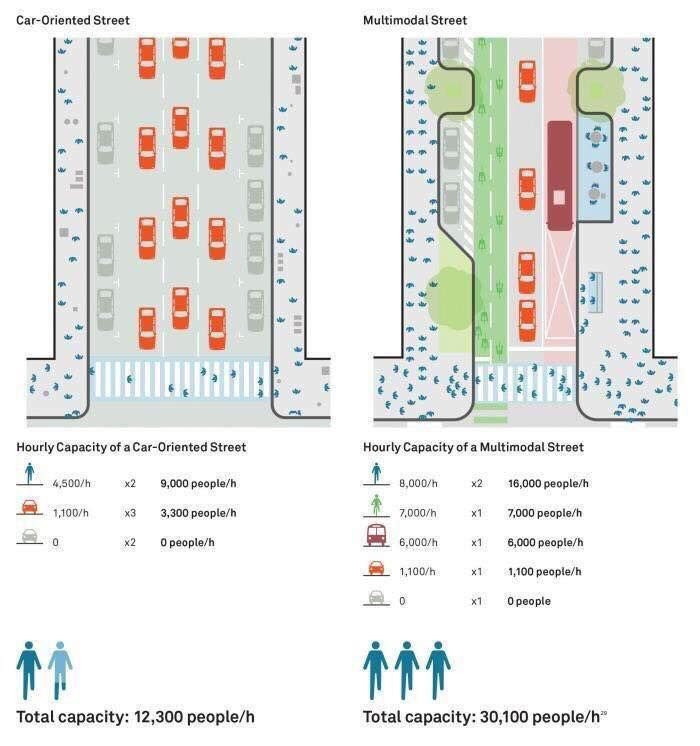
In the car oriented street (left-hand side), there are two parked-car lines plus three car lines plus two narrow sidewalks. The realistic estimation shows a total capacity of 12,300 people/h by summing every moving people. On the other hand, the multimodal street offers a different view. Based on the same surface, we have two width sidewalks plus a bidirectional bike line plus a bus line plus a car line. In this case figure shows that the total capacity is 30,100 people/h, more than double. In addition, trees and benches make the street friendlier. Thus, the selection of the best model is like falling off a log.
Intelligent mayors are introducing bicycle-sharing systems to improve the use of this ecological way of transport all around the world. Allowing citizens to use them at cheap cost increases the number of bikers on streets who adopt better habits in turn. As a result, cities and villages are benefiting from it as the air inhabitants breath is more convenient from a health perspective and the noise is reduced.
Although bike-share began in Europe in 1965, it was not until the 2000s that a viable format appeared thanks to information technology. Nowadays the public systems include technological advantages about which I will talk in the future. The bikes in the bike-share services varied as bicycles themselves do. There are normal and electrical bicycles, those which works with a card or a mobile app, with solid wheels or full of compressed air, etc. All these differences have impacts on the service. For example, the solid wheels minimize their maintenance since they do not poke, but it is easier to have an accident when raining.
One key element is the anchor system. If two pieces form the anchor, it is more complicated to put the bike on the station. On the other hand, if it only has one, metallic piece the action is facilitated. The bicycles weight is also another point to have in mind. Too heavier bikes discourage people to use them, whereas light ones are better specially if they move on a hilly city. Interconnection is also important mostly when close cities and villages have their own bike-sharing services. There is nothing more inconvenient that the obligation of changing the bike, and hence having for instance two bike cards, the moment you pass from one location to another.
To sum up, bike-sharing is a good way to improve the number of bikes, but before launching it, some issues should be taken into account.
