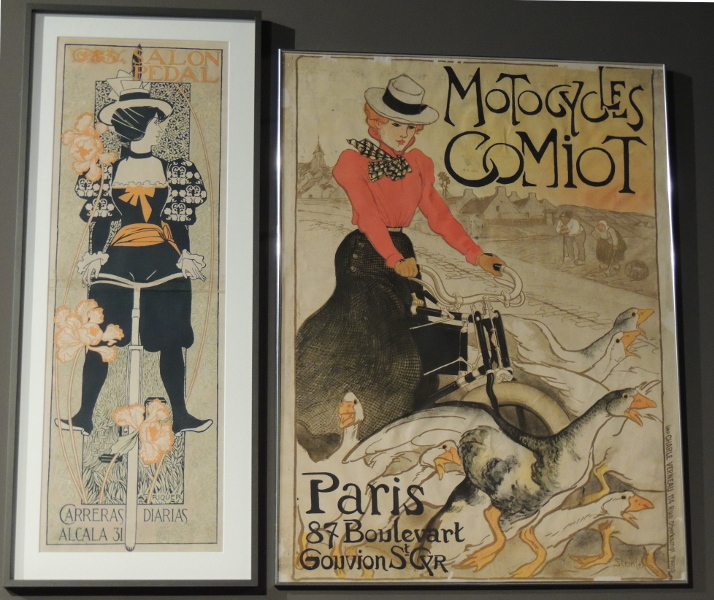
Ciclostura is the Spanish name of the art of making accessories from parts of bikes. Have you ever dream about a belt made of a tyre and a sprocket, or a backpack which most of its parts come from tyres? It sounds crazy and yet is possible. Each and every part of a bicycle can be recycled. In this case, the world of fashion is enriched with the variety of accessories and styles which are offered by Kaiowa. This Valencian company takes advantage of those bike objects which are rejected as the bicycle gets old. Tyres, inner tubes, bearings, sprockets, chains, trouser clips, you name it, are given a second life in order to allow more people benefit from bike. Usually, bikers have an ecological thinking and try to cooperate shoulder to shoulder with actions to reduce waste, noise and pollution, and improve quality of life.


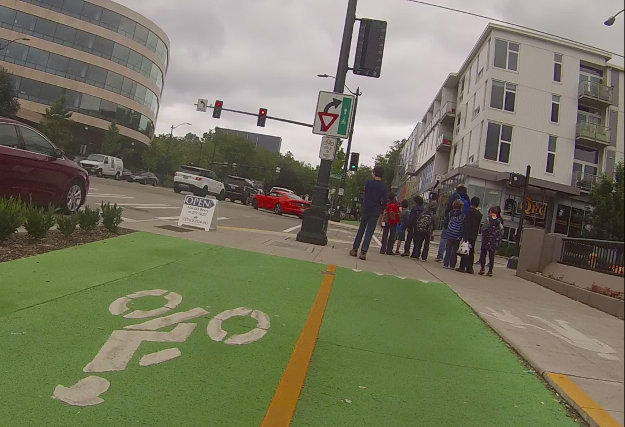
Paint only equals nothing.
Paint and flexi-posts equals nothing.
Paint and signals equals nothing.
I guess we need physically separated bikeways if we realistically want to see people biking in Greenlake.
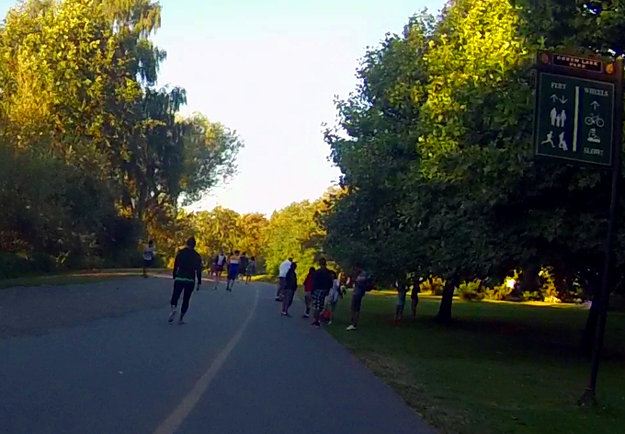
This is Seattle’s Burke-Gilman trail. Along it, bikes and pedestrians are told to share the trail, to walk on the right and the opposite, so everybody walks whichever way they feel like at any point. Can you imagine what would happen if Seattle treated cars the same way?.
Riding a bike is commonly understood as a way to practice aerobic exercise since there is not need to carry too much weight and its design eases riding even for fat people. Nevertheless, there are improvements like rear racks, bicycle trailers or bags which make it even light. From a healthy point of view, studies across the world have been done to determine to which degree riding is beneficial to people. The overwhelming literature conclude how good is to ride. By making regular cycling, the risk of death from all causes is cut by more than 40% and the reduction in the risk of cancer and heart disease is 45% (https://www.bmj.com/content/357/bmj.j1456). Mental health is also boost by biking. And the benefits are not only experienced by individuals’ health, but also the whole society (https://www.theguardian.com/environment/2017/dec/04/death-air-pollution-cut-if-uk-hits-walking-and-cycling-targets).
Just to name one paper, a scientific study (among others) (https://www.theguardian.com/lifeandstyle/2018/mar/08/cycling-keeps-your-immune-system-young-study-finds) demonstrates that cycling makes younger the immune system. Kind of rejuvenate oneself. It is marvelous. Moreover, it preserves muscles and helps maintaining controlled levels of body fat and cholesterol. Better than taking drugs, biking is an excellent allied for senior citizens. There is no need to use face creams to hold back the effects of ageing. Just ride a bicycle!
Do you want to have to pave bikeways over and over again because they are full of bumps and holes every other year?. Just make sure to install them very close to tall trees. Actually, even worse, just plant another row of trees on the other side too.


If you have a recreational boat Seattle’s bridges will raise for you stopping all traffic no matter what.
If you have a car the barriers will go up for you first.
If you walk, bike or are in a wheel chair, Seattle will treat you like a third class citizen. Specially if you use the Ballard bridge.
Ciclosfera is the name of the most important Spanish urban bike magazine. Its name comes from the words ciclo (cycle) and esfera (sphere), remembering the shape of the bike wheels, its movement and symbolically the non-stop evolution of it. It is the most popular one in Spain with around 100 pages. You can find it at bike stores and workshops in more than twenty-seven cities. Adds and subscribers fund it to allow it being totally free. What is it so important? Among the team of good reporters who write exciting articles, there is a wide range of themes which are treated. Security, bike-friendly cities, interviews, thrift stores, the last fashion, good photos, news, architecture, personages, followers interactions, round tables, cartoons, you name it. The last products from bike firms and parts producers are shown as well as bike culture in the broadest sense of its meaning. This quarterly magazine goes down a treat of urban bikers and gives ideas about how to improve a bike, a ride or the next travel. Furthermore, the most exciting bike events come under in a specific section every three months. It is extremely complicated to think about a subject which is not cover by Ciclosfera.
You can check it on www.ciclosfera.com (in Spanish). It is also presented in the social networks.
Do you know what happens when a bike way is made out of paint? Cars park on it. And if you add flexi-posts? Cars run them over when they park on it and they are all gone in a couple of months. Just have a look at the red car parked in the middle of the bike way after running over some flexi-posts.

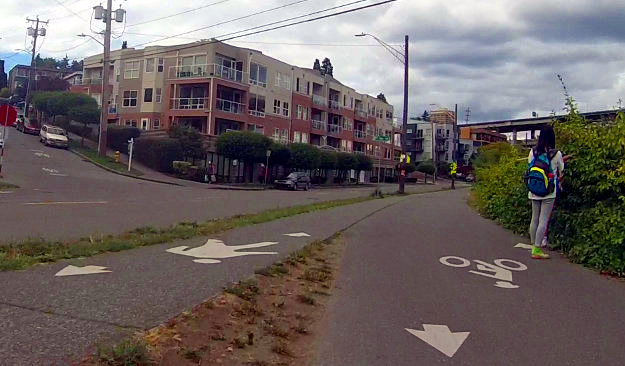
Do you want to give bikers a daily headache?. Then simply discontinue the bike way when it reaches an intersection. Even worse, also put a traffic light in the middle of it.