Why American public transit is so bad
Leave a reply
Arturello di Pópolo is one of the most impressive bikeclowns. This Argentinian man plays a show which is highly influenced by La Bicicleta, an originally humor, piece of art developed by Joseph Francis Jinarek. This Austrian bicycle winner suffered an almost crash when competing, i.e. the handlebar of his bike came off from the frame at high speed. Fortunately, thanks to a series of pirouettes and his balance skill, he could stop his bike, put his feet on the ground and open his arms. The public clapped enthusiastically and La Bicicleta show was born.
Arturo Chillida del Pópolo (Arturello di Pópolo) knew about La Bicicleta when he saw Jinarek son (Joe Jackson Jr.) performing it in a awards gala with the best bikeclowns back in 1976. He was so impressed that decided to perform its own La Bicicleta.
La Bicicleta consists in a two-characters play in which no word is pronounced. This apparently drawback does not avoid collecting a lot of laughs. It starts with a beggar clown who finds an alone bike. After checking the owner is far, he retains it. His funny problems start from this point, and I am not going to spoil them.
The impact of Arturello di Pópolo on La Bicicleta is considerable as the original play lasts about twelve minutes, whereas the di Popolo adaptation extends for forty minutes. However, their essence remains the same: Making people laugh similarly as all the other bikeclowns like Álvaro Neil do.
Here you can see some of his shows.
Handlebar is an essential part of every bicycle. It allows the rider to lead her bike into the selected direction. On the other hand, it determines the biker body position. It is specially important to increase the bike comfortableness when pedaling for long distances, like in cycle tourism or great journeys on bike. This way, ache in arms, shoulders and back is greatly reduce and even it disappears because our body weight rests in our butts.
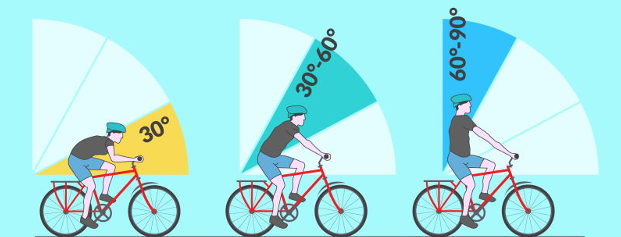
An additional advantage of adopting a more upright position on a bike by acting on its handlebar is that your field of vision is improved. This fact is much appreciated in urban riding due to the fact of you should pay attention to cars, pedestrians, other bikers and traffic signs. Moreover, initiating a ride is easier with a upright back as well as natural.
It the next picture you can see how different is the field of vision depending on your back upright:
The traditional way of maintaining the equilibrium when pedaling consists in using training wheels when you are a child, and once you dominate it move to just two wheels. This target can take more or less time, but ultimately we all reach it. Fortunately, you will never forget it.
Apart from the most used technique I have indicated, there are some others probably innovative methods that have demonstrated their effectiveness. Some of them are:
Using a balance bike instead of a bicycle with training wheels: This way the kid gets use to a bike shape and weight, as well as she develops the equilibrium needed to ride a bicycle.
Taking the pedals off a bike and lowering the seat: Here, the target is convert the traditional bicycle into a balance bike. The goals are the same as in the previous point.
Tell your child to turn in the direction that she is falling: This maneuver allows her straighten out and helps dominating her body and the bike when a falling is about to happen.
Raising the training wheels a little at a time, so that she thinks her bike uses such wheels, but in reality it does not. When she realizes that she does not use training wheels, she will not use they anymore.
There are additional techniques to learn riding a bike that have been developed thoroughly by experts in the field like this one.