Zwolle opened an underground bike parking
Leave a reply
I open a three-post series dedicated to psychology and bicycle. The subject of psychology is a field so large that it can not be explained in detail here. Rather, I am going to give some broad brushstrokes.
The first one is the use of psychology as a trick to teach someone to ride a bike. In particular, I am writing about the use of operand conditioning for such a purpose. Operand conditioning is the use of rewards and punishments effectively to encourage and teach whatever behavior to anyone. This theory was explained by the behavioral psychologist B. F. Skinner in the midst of the 1900s. Specifically, he claimed that learning involves changes in behavior in response to external stimuli. Do not confound this theory with the classical conditioning which involves reflexive, involuntary behaviors.
In operand conditioning, a reinforcement is anything that encourage or strengthen a desired behavior. A positive reinforcement may be giving something that a person really enjoys after the target behavior is done. On the other hand, negative reinforcement means stopping or removing something that the person does not want. For instance, when teaching how to ride a bicycle to a child, a negative reinforcer could be a day without chores, whereas a positive reinforcer is encouraging words.
Moreover, operand conditioning contemplates punishment. Again, punishment can be positive (introduction of something unenjoyable after a behavior: use of angry words) or negative (restricting access to something enjoyable such as taking away TV or play time).
Overall, punishments are less effective and desirable than reinforcements, being positive reinforcement the most effect conditioning method. Thus, you could try to minimal punishment (better: no punishment) while teaching to ride a bike. The better strategy is reinforce each small step because every step makes a path with teaching how to ride a bike as the finish line. Such action allows teaching to ride a bike faster since the novice gets encouraged and enjoys the process. Furthermore, reinforcements should be sincere, otherwise the learner will not take it seriously.
How bicycles balance themselves has been a mystery for ages. Intellectual and curious people have studied how it is possible that you do not fall from a bike while pedaling since the nineteenth century. The bicycle self-stability was explained as the sum of the gyro and caster effects. The gyroscopic effect (gyro effect) of the spinning front wheel is described by the equation of the gyroscope behavior: The torque on the gyroscope applied perpendicular to its axis of rotation and also perpendicular to its angular momentum causes it to rotate about an axis perpendicular to both the torque and the angular momentum. This rotational motion is referred to as precession. And the bike design is to help steer the front wheel into the direction of a lean.
On the other hand, the caster effect is the measure of how far forward or behind the steering axis is to the vertical axis, viewed from the side. Bicycles benefit from the positive caster effect as their steering axis is “in front of” the vertical line.
Surprisingly, scientific studies have demonstrated neither the gyro effect, nor the caster effect are needed to balance bikes. In fact, researchers built a riderless bicycle with two small wheels, each matched with a counter-rotating disk to eliminate the gyro effects, and with the front wheel contact point slightly ahead of the steering axis, giving it a negative caster effect. They launched the bike at more than 5 mph and it balanced itself.
Researchers highlighted the importance of bicycle designs since they “found that almost any self-stable bicycle can be made unstable by misadjusting either the trail, the front-wheel gyro or the front-assembly, center-of-mass position,” the researchers explained in their paper.” (Science, April 15, 2011)
Moreover, they added “conversely, many unstable bicycles can be made stable by appropriately adjusting any one of these three design variables.” Hence, bikes design is important to maintain self-balance.
The XVI Iberian Congress: “Beyond mobility” on bikes and cities took place in Cascais, Portugal, from May 2nd to 4th, 2019. This annual event started back in 1996 thanks to the support of ConBici (Spanish Coordinator in pursuit of Bicycles) and FPCUB (Portuguese Federation of Cycle Tourism and Bicycle users). The Covid-19 made it impossible in 2020, and there is the prevision of continuing with it in Barcelos (Portugal) and Barcelona (Spain) in 2021 at the time I write this post.
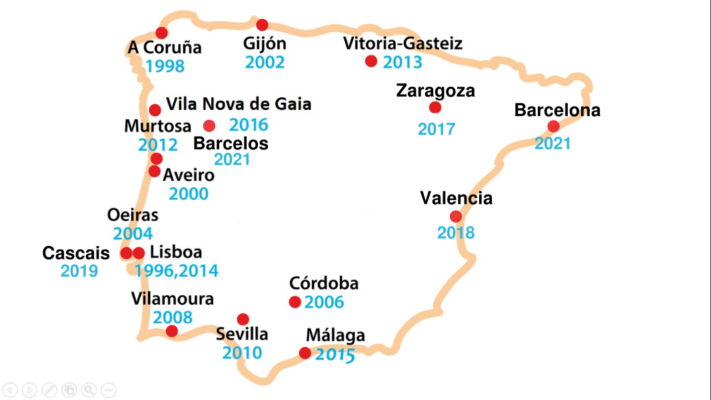
Audiences enjoyed speeches about a variety of subjects such as improving communities to strengthen the bike movement, better accessibility, how bikes enhance economy, EuroVelo (the European bike line net to cross from one country to another without stopping pedaling), environment and health, raising cycle tourism or Velocity 2021. Moreover, participants uplifted their mood in the bike ride and local cuisine in the 3-days congress.
It concluded in:
The need of norms and laws in the bike building process to ensure security
The debate proposed bikes as part of economic accessibility and a boom of local economy in comparison of the car counterparts
The challenge of bikes in Africa, with special attention to the lack of bicycle infrastructures and the stigma of relating this way of transport with poverty
Transporting senior citizens in bikes, fro instance cargo bikes, helps benefiting local communities
Promoting bike use in schools makes societies less dependent of car and petrol
Such change is importantly improved when favorable laws and figures of reference, mainly parents, contribute
The congress also pointed out the need of technician training to create well prepared persons who design bike infrastructures
Another spot was the lack of reliable studies regarding the economic impact of bike on society and the hope of the BooST “Boosting Starter Cycling Cities” project will solve part of it
Moving from car cities to decarbonized cities
Promoting open data acquisition in regards of sustainable mobility
Intermodality
One of the key concepts to fight against climate change is to allow people use non- or small-pollutant ways of transport. This fact, along with reducing space and infrastructures dedicated to noisy, contaminating transports, has been promoting in the most advanced countries for decades. One clear example is the Delft train + bike station (in The Netherlands) . This exemplar infrastructure enables thousands of people moving long distances under a comfortable, green model. Intermodality (1, 2) means just it: To transport people or things by using multiple modes of transportation. The good point in the Delft infrastructure is that the carbon footprint and the cost of using the station is considerably reduced in comparison with driving a car or a motorbike the same distance.
Why is so special this station? The Netherlands is well-known for being a paradise for urban cyclist and its developed railway system. So, they determined killing two birds with one stone. The Delft station was built thinking about the thousands of bikes one can see on a daily basis in the city. The result is a massive bike parking for 5,000 bicycles with natural light. A person arrives at the station by pedaling, locks her bike and takes the train. So easy, so powerful. What’s more, one can put it there for 14 days by free.
The modern bike parking sits of the floor and the train station is bellow it. But due to the fact of the enthusiasm people have shown with this infrastructure, there is an additional bike parking for 2,700 more bicycles close to the station. Well done!