Borders matter

Do you know why drivers and pedestrians usually feel safe?. Because there is a concrete border separating them. That, and a row of parked cars, traffic lights, street lights, mailboxes, trash cans, bicycle racks, trees, bollards and what not.
When I ask people the main reason they don’t bike, it’s because they don’t think it’s safe. And I can’t blame them if in your city the only thing between you and speeding cars is paint.
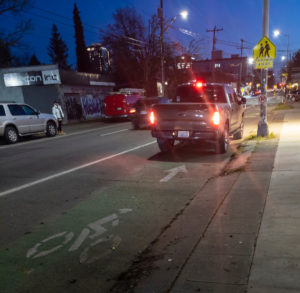
I just took the picture above a couple days ago. Do you see the big car, parked in the middle of the bikeway, next to a not parking sign?. You may wonder what was it doing there. Well, it was there because, while driving on the paint only bikeway, it almost ran over a biker. And this isn’t an isolated incident. When I bike I see cars taking the paint-only or flex post bikeway daily. You name it: ambulances, UPS/ Fedex vans, moving companies, Ubers, pizza deliveries, random drivers, etc. Most drivers do indeed respect paint-only bikeways, but with the amount of people driving, a small percentage of inconsiderate drivers keep a lot of people from biking.
A few days ago I found this tweet, and the question is totally legit. That temporary bike way, separated with big, plastic Jersey walls, is much safer than regular bike ways.
So what are the alternatives when it comes to borders for bikeways? Let’s see:

  • Paint: Low initial cost but ineffective with careless drivers. They need to be repainted as cars run over them.
  • Parking spots: Low initial cost and effective with careless drivers when occupied.
  • Flex posts: Moderate initial cost but ineffective with careless drivers. The posts need to be replaced as cars run over them. I’ve seen a whole street of flex posts lacking half of them in half a year.
  • Small border (half a feet tall): Moderate cost, small physical barrier, inconsiderate drivers will hit it before running over bikers, but they need to be replaced and realigned as drivers hitting them also move them.
  • Bollards: Moderate cost, visible from the driver perspective, will only work against inconsiderate drivers if they are made of and filled with steel and concrete.
  • Vegetation (planters, bushes, trees, etc): Higher cost plus periodic maintenance, improve air quality, but must be kept trimmed so they don’t reduce visibility.
  • Big barrier (as in concrete or plastic Jersey walls, etc): Higher cost, large physical barrier, very visible from the driver perspective, careless drivers will have almost no effect on bikers.
  • Detached (as in there’s a small sidewalk between the bikeway and the drivers): Higher initial cost but really safe against inconsiderate drivers.

Also, relying on borders alone to protect bikers from inconsiderate drivers is a bad idea. Borders complement an environment with enforced and reduced speed limits. Here in Seattle most streets are limited to 25mpm/40kmh. Meanwhile, in cities like Copenhagen or Barcelona it’s 30kmh/20mph.

Another thing to take into account is consistency: I’ve biked in cities where the bikeways were painted green, red, empty, and sometimes asked people to bike on the right while other times they asked we ride on the left. You’d never do that to pedestrians or drivers. So choose the best way (ideally look at the Netherlands and Denmark) and replicate it all over the city.
faltantornillos.net

EuroVelo

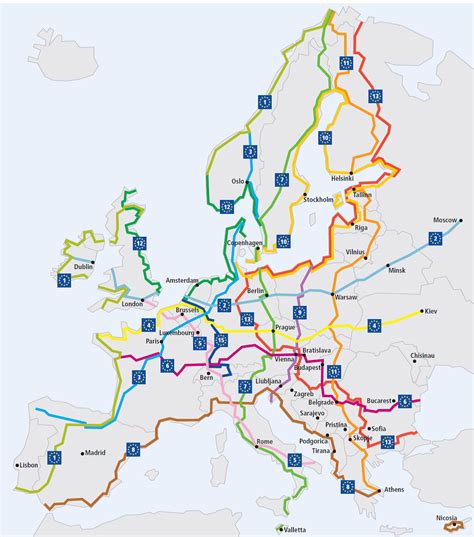
Imagine bike lines to ride throughout European countries, from north to south, from east to west. This awesome idea is EuroVelo. EuroVelo improves European cycle tourism among countries. Indeed, one can cycle from one point to another just enjoying the landscape and cities you encounter in your path. EuroVelo is a project of the European Cyclist’ Federation. When completed, the EuroVelo network’s total length will almost be 90,000 km (55,923 mi). The routes are made of both existing national bike routes as well as existing general purpose roads. In addition, there are new stretches of cycle routes to connect them.

EuroVelo routes do not look for fast cycling, rather they are appropriate for relaxing pedaling while imbuing with the essence of the places you visit. All the routes are appropriate to bikes, but you should be prepared in case of bad weather. Moreover, you can book routes in the EuroVelo web with important information such as route duration, difficulty, elevation, tour type or suitable types of bicycles.

There are nineteen international routes in EuroVelo: Atlantic Coast route, Capitals route, Pilgrims route, Central Europe route, Via Romea (Francigena), Atlantic-Black sea route, Sun route, Mediterranean route, Baltic – Adriatic route, Baltic sea cycle route, East Europe route, North sea Cycle route, Iron Curtain Trail route, Waters of Central Europe route, Rhine cycle route, Rhone cycle route and Meuse cycle route. Each and every route offers bikers a myriad of possibilities to know new cultures, cuisine, monuments, nature, people, museums, castles, you name it. Just get inspired.

Rosario Pino

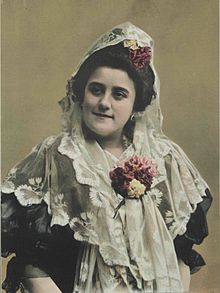
Rosario Pino (1870-1933) was a bike pioneer in Spain at the end of the 19th century. She worked as actress and first appeared in a painting in the magazine El deporte velocipédico (The Velocipede Sport, a velocipede was a type of 19th-bicycle) in February 1896. At that time, bicycles were expensive devices that only high-class people, mainly men, could afford it.

Her image represented a terrible blow to the macho and patriarchal mentality since they claimed against women in trousers on infernal machines. The very same magazine published where Rosario appeared also showed a journal article in which the French doctor Lèon Petit explained a positive view of women riding bikes. For instance, he denied the absurd legends of relating women infertility, hirsutism and lack of sexual desire to bicycle. To the contrary, he approved women on bikes in order for them to enjoy a healthy life which in turn will contribute to bring more babies to the world.

The provocative picture of Rosario Pino boosted the Spanish women to use bicycles and is considered part of the fight for female civil rights. In fact, Susan B. Anthony, the American Suffragist Association president, affirmed “I think [the bicycle] has done more to emancipate women than any one thing in the world. I rejoice every time I see a woman ride by on a bike. It gives her a feeling of self-reliance and independence the moment she takes her seat; and away she goes, the picture of untrammelled womanhood”. Bicycles are symbols of equality because if men could make bike rides, women also could. For example, Marthe Hesse ascended the mythic Tourmalet mountain, France, without setting foot on the ground in 1902. Moreover, there were female bike competitions in Buffalo, Paris, Aix-les-Bains (France), Manchester (England) or Glasgow (Scotland). Female racers used the bloomers trousers, by Amelia Bloomer. In Spain, the first female bike race took place in 1935. The Ventas Cyclist Club organized the 22 kilometers race and Angelita Torres won it.
However, Rosario Pino rode in a relaxing way to go to wherever she wanted without the help of a man. She rode to the end of her days.

From the financial assistance to the bike movement in order to promote biking

When we were in the worst state of pandemic, some governments gave financial assistance to citizens to buy environmentally friendly ways of transport, mainly bicycles. Bikes allow private, mostly individual displacements while maintaining safety distance with other actors in the road, two good points in favor of fighting against Covid19 as we know. Another area covered by this money was the transformation of a conventional bike into an electric one. This point has sense specially in hilly or too extensive zones. And data showed a boom in the use of bikes in the next months.

A different impact of such an action could have been an increment in the cost of bikes. Since people have more money to spend, bicycles could cost more. This is an immoral approach because the financial assistance did not cover all the petitioners, thus many could have been expelled from the interesting assistance. I do not even like to think about what could have happened if a piece of news explained that the bike shop X or the bike manufacturer Y had increased the cost of bikes in these days. Surely, the branch would have need to invest substantially more money than the extra gained income as a result of the bike movement which only wants to populate roads with bicycles. Regarding its influence, the bike movement has made possible happier people, taking care of the planet or, indirectly, looking after bikers health. Concrete events like the Critical Mass, the European Mobility Week or the Iberian Congress, just to name but a few, have contributed to promote the bike use.

More and more people ride their bike every year. Thank you!