I am so Sick of this Lazy Excuse (for bad cities)
Leave a reply
Bicycles have been using for more than pedaling and one of the alternative uses is helping people lives. I wrote about Soterranya and its impressive work by recovering bikes in bad state, fixing them and donating them to persons who need them. At the time of writing this post, Soterranya has given more than 3,000 bikes and actively participated in the recovery from the Valencia, Spain, DANA in the next months after October 2024 in those villages more negatively affected.
Another inspiring example is BSF (Bicicletas Sin Fronteras, Bicycles Without Frontiers) (https://www.bicicletassinfronteras.org/, in Spanish). It was born in 2015 and has donated more than 2,700 bikes to the Senegal population. Its aim consists in helping local people by giving bicycles to students, instead of walking kilometers to school, to improve their academic performance, promote employment and strengthen communities to them. Their baobikes system is locally managed. All in all, the most complicated was to change the white-man mentality, and understand and adapt to their local culture. Romà Boulé, the BSF responsible, affirms that they have received requests from other countries, but he remarks the need of local entities which know the area, and have enough technical knowledge and economic support for such a project.
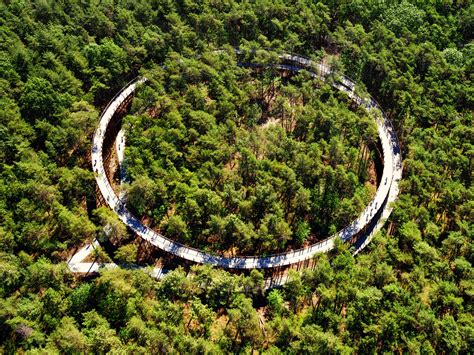
Riding a bike has direct impact in protecting environment and trees. The relation between bicycles and trees is expressed to a higher degree at the Bosland National Park (Belgium). Here, not only you can pedal close to trees, but also close to its leaves. This is due to a special bike line between Lommel, Hechtel-Eksen and Pelt known as Fietsen door de Bomen or Cyclign through the Trees. This massive bike circle has a slope of 3% – 4%, is 700 meters long and one 3 meters unidirectional line.
The perfect integration of this infrastructure and nature makes the experience magical. Its designers tell proud that they had in mind flora and fauna respect to determine the bike line. Additional technical issues like the use of minimal machine in the national park or the final ensemble were also put into practice. A metal mesh protects bikers from falling from the top of the bike line.
The other day I was on my way to buy some groceries when I saw something undesirable that I was expecting for some time.
I saw many cross calls in the past, but that day Is aw it first hand: bikes are force to cross over a bikeway in a non-standard way, and one bicycle was trapped beneath a car because the driver wasn’t paying attention.
Painting a bikeway is very flashy, but it doesn’t change anything if other users aren’t paying attention. Not to mention that over time that pain washes away. Plus this is not an standard crossing.
Some ideas for better solutions are keeping all crossings standard, making sure that turning cars don’t follow the same traffic light as the traffic going ahead, and keep bikeways physically separated from roads, especially at intersections.
PS: nobody suffered life threatening injuries, but the bicycle rear wheel and frame were destroyed.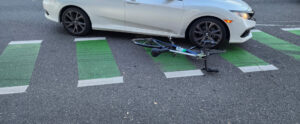
Every Sunday in Bogota, Colombia, is different thanks to Ciclovia. From 7 a.m. to 2 p.m., streets become more human, quieter and peaceful. Ciclovia was born 50 years ago when the independent organization Pro-cicla closed the first streets to pollutant vehicles on 15th December 1974. It congregated 5,000 people who protested against pollution, cars and lack of leisure alternatives in the city. In June of 1976, the mayor made it “official” through decrees 566 and 567. As time passed by, the number of kilometers for people on Sundays diminished to 20, until Ciclovía was managed by the Secretaría de Tránsito y Transporte and the Instituto Distral de Recreación y Deporte. Today, more than 80 kilometers are closed every Sunday. Even more, there is the Ciclovia Nocturna (Night Ciclovia) which consists in closing streets twice in August and Christmas. It started in December 1999 and three million people enjoyed it.
As it comes to the types of people who take advantage of Ciclovia, the earlier risers are the cyclist who preferred making sport since they go to Patio, Guadalupe and Montserrate hills. Next, families with children use streets as playing grounds. After them, other bikers, skaters, senior citizens and walkers join the celebration. Finally, food sellers, gymnastic groups and sometimes live concerts contribute to make it a party.
The success of this event goes deep into transforming an area into a democratic and universal surface. Not surprisingly, it has been exported to other cities within Colombia, Chili, Mexico and USA.
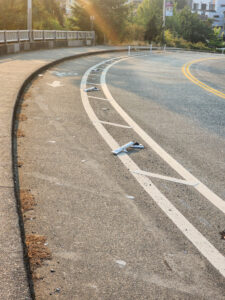
When a new infrastructure uses flexiposts it looks great at the beginning, but after a couple months you realize it becomes useless because some people driver over them and the flexiposts eventually disappear altogether.
It’s much better to use durable alternatives such as big flower pots, landscaping, armadillos, concrete curbs and so on.