Category Archives: Opinion

Bungee cords

When transporting goods in a bike, one can put them in a basket or in a bicycle bag. There is a third option which consists in tying them to the luggage carrier with one or two metal bungee cords. Bungee cords are composed of one or several strands forming a core covered in a woven cotton or polypropylene sheath.

They are ideal for such a purpose as they are elastic, thus allowing to use extra length and making more pressure at the same time. Indeed, they end in hooks at their extremes in order to ease their anchorage. It is quite recommendable not to anchor the moorings directly into the luggage carrier, rather it is better to give a spin to the cord extreme you want to anchor to the luggage carrier and then put the hooks into practice. This is because you do not want the bungee cord extreme to be released in the middle of a ride and this way the anchor is secured. If you are thinking in buying bungee cords, I recommend to invert money in good, high quality ones since they will last much more time.
Changing habits

Let me tell you a story that has been repeating from the past century. We have a street and car stuck occurs often. Suddenly, one visionary says “Eh, we must improve the number of car lines so that cars won’t be in stuck anymore”. And then the street passes from two car lines to four ones at the expense of space for pedestrian. As a result, the number of cars also increases and car stuck comes in a few days. In this case the problem is even greater because space for pedestrian has been reduced and the more cars, the more pollution and noise.

One common argument of those who are blind to the improvement in sustainability produced by bikes lines, is to say that car lines reduction would be make everybody worse off. Note that the everybody in italic means “only themselves”. As the story I have explained earlier indicates, improvement in car infrastructure only causes more cars on streets. On the other hand, making bike lines on roads (and then reducing at least one car line) makes citizens better off as air quality improves and noises reduce. Moreover, as bikes take up less space as cars do, it is common that pedestrian space increases as bike line is built.

When car lines are reduced, dimwit car drivers blame against bike infrastructure instead of changing the car for the bike, the public transport or just walking. Replacing a habit by another is costing but if only they be open-minded enough to realize that everybody (now meaning each and every person) get better and improve their health.

Road tax for bikes?

One of the main claims in the less developed countries regarding bikes and sustainable mobility is that bicycles should pay a road tax. This usually comes from scared car drivers who see how the bicycle trend takes car lines and transform them into bike lines. Or also how pacification of traffic does not allow them to drive so fast and consequently force them to fulfill the traffic law. This anger scream represents the loss of a false liberty in essence.

Today I am going to focus on the proposition of road tax for bicycles. Why does road tax apply to cars? Because of the negative impacts it has on society. Cars occupy too much space in streets. Approximately, one car has the same surface as eight bicycles. It also impacts negatively on the pavement as one ton (2,204 pounds) machines passing on by thousands or even millions every year on the same streets cause wear in impressive magnitude. Compare this fact with the usual weight of bikes 10-15 kg (22 – 33 pounds) or even less if the frame is made of carbon fiber. Furthermore, road tax is also paid as a result of all the diseases and health problems the poison of exhaust pipes expels. It would not be fair if all the people pay for problems caused by a fraction of the whole population. Not to mention the deaths car causes because of car accidents.

To sum up, it would be a nonsense if bicycles pay the road tax as they do not provoke as many problems as cars do.

Street users pyramid

Every day you share the street with other people who walk, use a wheelchair, ride a bike or drive a motorcycle, a car, a van, a truck, etc. There is a myriad of ways of moving from one point to another. I like to think it as a pyramid regarding the protection each group should have. On the bottom of this gradation, there would be walking people and wheelchair users since each and every person belongs to this group and are the most vulnerable. Next, bikers and skaters would take up the second step. They go faster than most of walkers. This fact determines they should ride in a different, separate space in the street in order to avoid accidents and troubles. Then, we have the motorcycle drivers. Obviously, the speed they reach is the higher up until now, but they are fragile compared with car drivers. It is no difficult to imagine who would be worse off in an accident between a motorcycle and a car. On the top of this pyramid I put car, van and truck drivers. Since they move in the heaviest machines, the potential damage they can cause in road accidents is the most important. Indeed, it is common that most of deaths in road (at least in Western countries) are car drivers.

The helmet

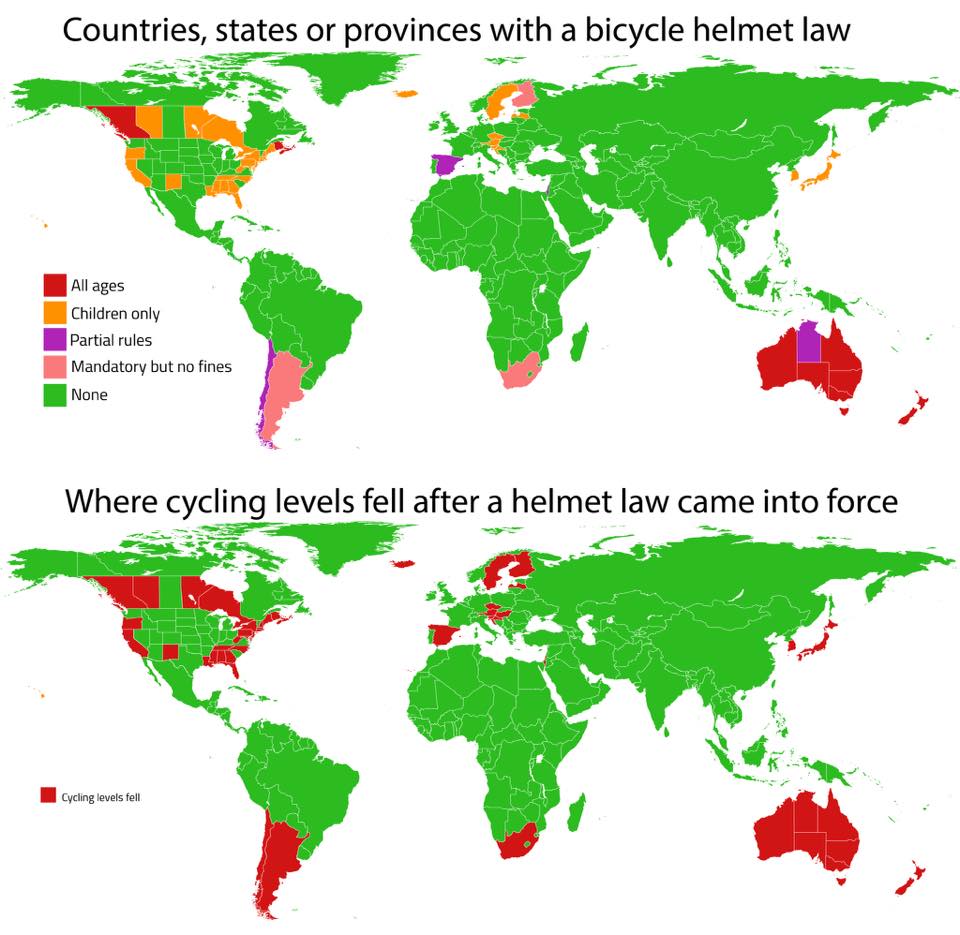
The use of a helmet when riding a bike is always a controversial issue. Some people argue that it can save your live in an accident. Some politicians have pushed its use with specific laws just to follow the previous point. Curiously, the same politicians do not ride bikes. They prefer driving cars. They also think helmets are a kind of titanium armor, able to stop bullets and space rockets. I think the statement is false in most of the cases. The true key is that the helmet does not save your life in a car accident, the car speed does. Studies show that the more car speed, the more probability a cyclist has to die. The probability a biker lives in an accident driving the car at 50 km/h or approximately 31 miles/h is less than 10% and it diminishes as car speed increases. Moreover, the low speed bikes reach, normally bellow 25 km/h or 15.5 miles/h, makes it unnecessary. The helmet use is compulsory in some countries and areas. What was its impact on the number of biker use the next months after approving by law? They have discouraged bikers to use the bike.


To sum up, forcing bikers to wear helmet is not a correct way to improve bike use or reduce cyclist deaths. It is better to force cars to drive slower, not to mention the fight against climate change.

Bike line or street?

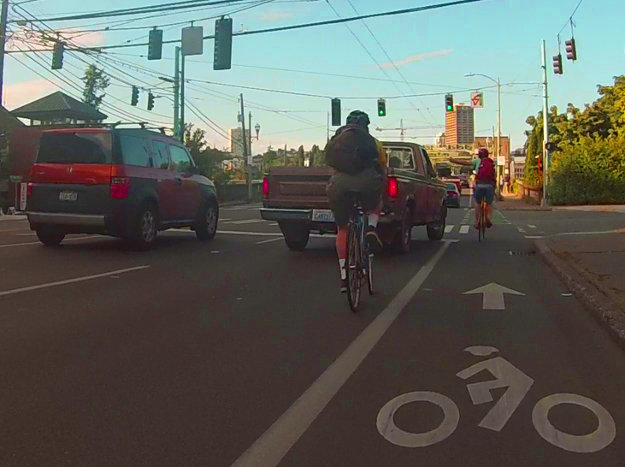
There has been a recurrent discussion among bikers who live in large cities regarding which infrastructure is the best to ride. On the one hand, we have bike line and on the other one the whole street. Both sides offer points in favor and against. Cyclists who ride on a bike line enjoy a dedicated space for them which is respected specially in the cases in which it is separated by a physical barrier from pavement and car lines. They feel this separation as a privilege with a potential effect on avoiding traffic accidents. This fact encourages those who are learning to ride and makes bikers who do not want to ride at high speed happy. It seems to say “Hey, we drive a vehicle, but we live in a peaceful manner not as the pollutant cars”. On the contrary, pro-street bikers say “Hey, we drive a vehicle, so we are traffic and must share the street”. They feel traffic has to be calmed down, not by cornering them but by forcing cars to reduce speed as bike do not usually reach high speeds as cars do. This type of cyclists often complain about the facts that bike lines often zigzag and their surface imply deficiencies, whereas streets often follows direct lines with better asphalt. Which position is the best? Neither, it all depends on the particular circumstances of infrastructures and the way of thinking of every biker.

5pm madness

5pmMadness1
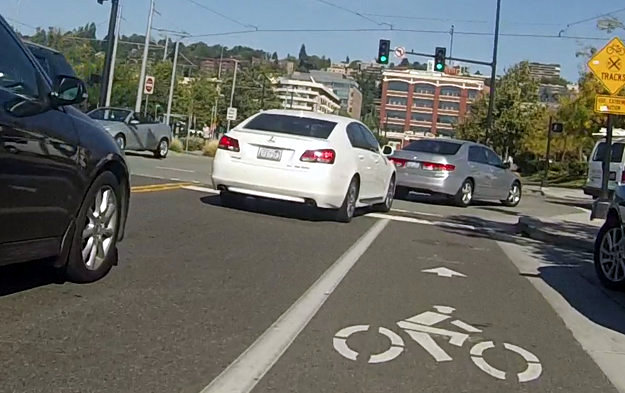
Just like werewolves get wild at full moon, and gremlins get really angry if they are fed after midnight, inner cities are a madness jungle at 5pm in the US.
5pmMadness2
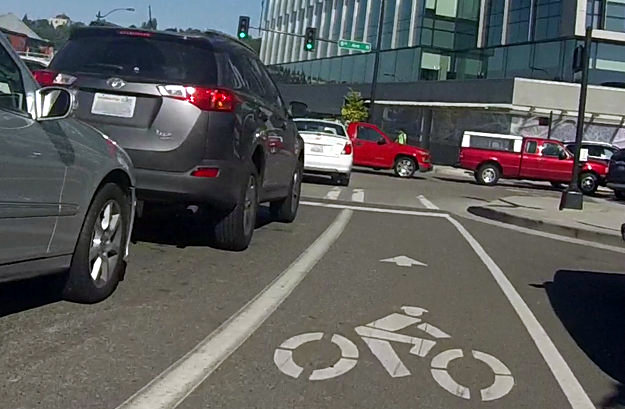
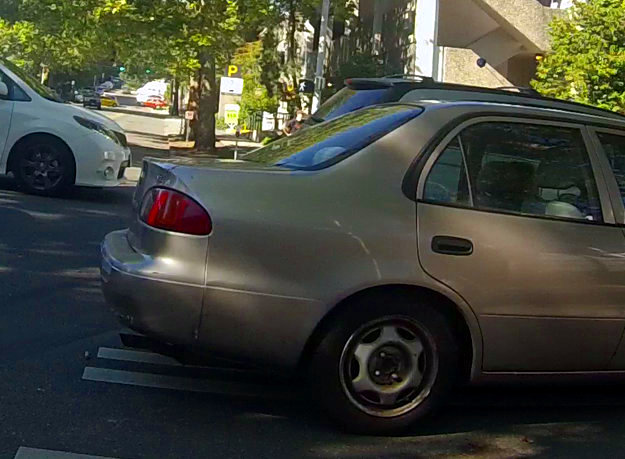
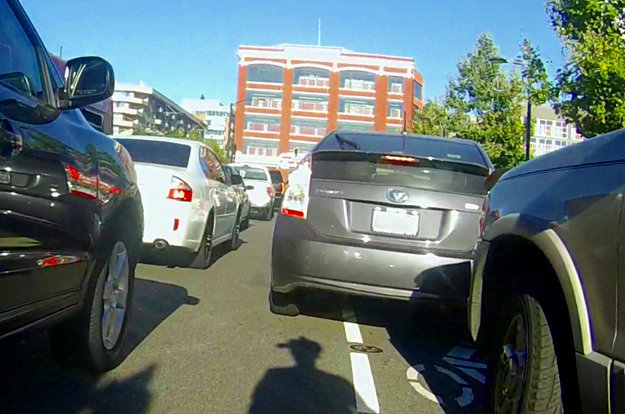
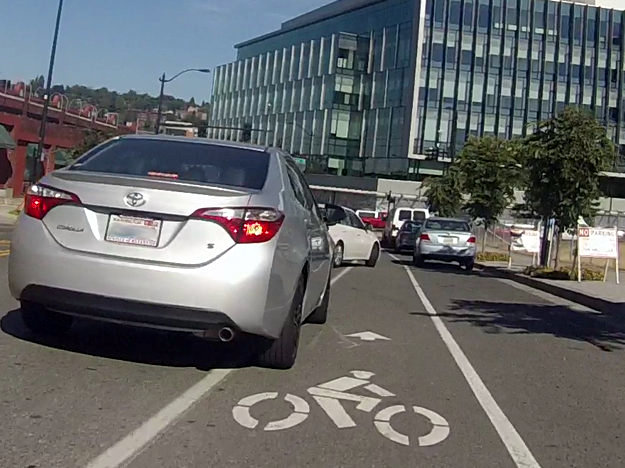
Drivers block the intersections, stop at crosswalks, invade bike ways, and honk the horn for no reason.
5pmMadness3
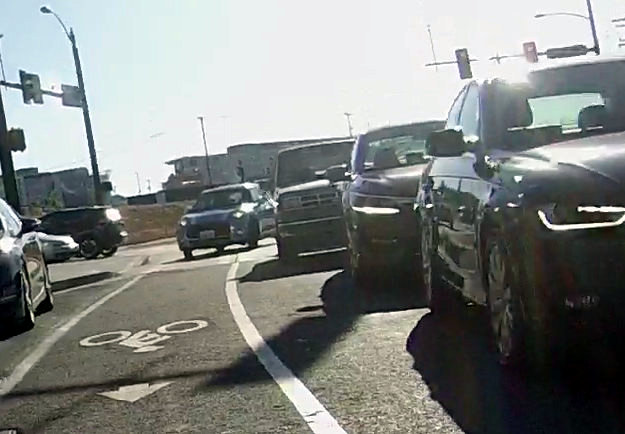
Adrenaline pumps up, anxiety jumps, futile attempts to advance are tested, and resignation skyrockets because you are stuck in a traffic jam.
5pmMadness4
And in places like Manhattan this is the norm.
5pmMadness5
A couple days ago a fellow biker asked me “Do people just get crazy when they’re driving?”.
5pmMadness6
This is the result of 50 years of wrong transit policies by misguided politicians. And there are simple solutions that could solve it in a matter of months, here are some I’ve seen working in other countries:

  • Build free, big parking lots outside of downtown and have fast public transportation take you there.
  • Pedestrianize popular streets which, by the way, will have a positive impact on those retailers sales.
  • Every month, the police department should start a new awareness campaign. The sheriff appears in mass media warning drivers they are going to enforce something, lets say, blocking intersections. After a week, every single car that blocks an intersection gets a ticket no matter what. And after a month, we move to another campaign. In half a year transit safety improves exponentially without installing any additional infrastructure.

faltantornillos.net

Our enemies, our allies

Biking in a city with a huge car usage feels like a struggle, like a war for the future with clear enemies and allies, and here are some of them.
Our allies:

  • Polite people
  • Nature lovers
  • 99.9% of the people
  • Health conscious people
  • People who love their life
  • Progressive urban designers
  • Politicians aware of the potential to win votes

Our enemies:

  • The stress level
  • Tight schedules
  • Closemindedness
  • Driver’s cellphones
  • The lack of empathy
  • Any drug taken before driving

OurEnemiesOurAllies

faltantornillos.net