Author Archives: admin

Healing wounds

During the 50s and the 60s things where wrong, really wrong, when it comes to transportation diversity. The car filled the gap of the American dream: a big house on the suburbs and a work downtown required a way of transportation suitable for very low density in an individualistic society. Long and wide roads were built, and enormous wounds in the form of highways divided entire cities.

Most people here in Seattle love Vancouver, Canada. People mention how beautiful and nice it feels and here is one key thing: it isn’t crossed by a highway in the way most American cities are. Having a highway-divided city has one potential advantage: fast commuting. However, every single day its capacity is exceeded and urban highways are full and slow at peak hour and when there is a big event. Moreover, the properties around it loose value since nobody wants to live next to a source of pollution and noise. Not to mention the fact that, if you have a business and you aren’t a big brand, nobody driving on a highway is going to see you and take a detour to stop by.

Luckily, though, the US has been healing these wounds. A clear example is San Francisco’s embarcadero area. Previously a noisy double decker freeway, the 1989 earthquake helped transform it into a beautiful open space that attracts a lot of tourists and locals.
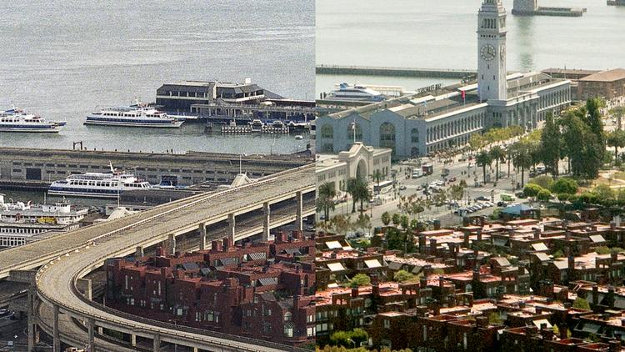
embarcadero

A similar thing could be said about Boston’s Big Dig which, despite having some issues, managed to substitute a high density highway with a more pleasant open space and nature
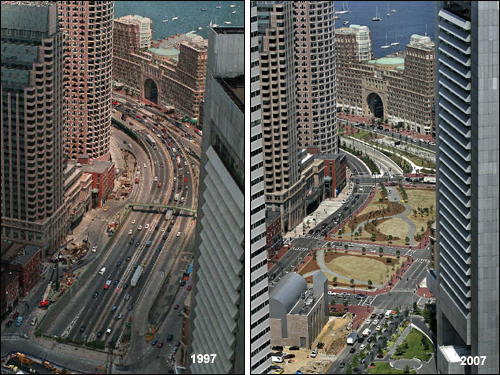
bigDig

And it isn’t only roads, Chicago’s Millennium Park turned a bunch of railroads into one of the most popular spots in the city. And Barcelona’s railways were rebuild underground to improved the whole city.

And now, Seattle, what are you waiting for?.
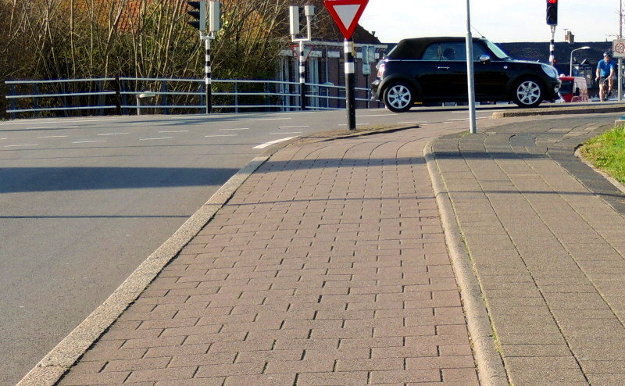
faltantornillos.net

The ideal bike way

Something apparently so simple, yet so often made wrong. Bike ways are key when it comes to urban planning. And rather than building miles and miles for statistical purposes, one should consider them as the main point to make vulnerable users feel safe.

in order to do so there are a number of points to consider, here are some:

  • Bike ways should enable anybody to bike safely.
  • Bike dispensers and racks should be placed next to bike ways.
  • Bike ways intersections must be designed in order to avoid conflicts.
  • Bike ways should cover the whole city, more so in areas with high density.
  • Bike ways should be physically separated both from cars and pedestrians.
  • Bike ways should be evenly paved since most bicycles have no suspension.
  • Bike ways should be placed far away from parked cars to avoid being doored.
  • Bike ways should be wide enough to accommodate more than one bike at a time.
  • Bike ways should not be used to carry rain water and puddles should be promptly fixed.
  • Speed limits should be lowered in the areas surrounding bike ways, if not thruought the city.
  • Bike ways should follow a standard through the city, instead of using cyclist as guinea pigs.
  • Bike ways should be easy to identify so that people don’t inadvertently drive or walk on them.
  • Bike ways should be placed far away from big trees to avoid expensive and often repaves.
  • Intersections with bike ways should be kept clear and without plants or objects that obstruct the view.
  • Bike ways should be kept as flat as possible and provide alternatives to hills so that everybody can bike.
  • Bike ways should be properly illuminated since even the most prepared biker can end up with an exhausted battery.
  • Bike ways should be placed far away from highways and dangerous roads, even one block makes a huge difference.
  • Bike ways should be paved with red asphalt or bricks, instead of black asphalt painted red or green, to avoid having to repaint them.

Bikeway Amsterdam
faltantornillos.net

The Netherlands, then and now

Biking in the Netherlands is like a dream: physically separated, perfectly paved bike ways take you all around and make you feel safe while on the road. Children, workers, and retirees commute by bike and they are promoting it more and more.

However, it wasn’t always like that. Back in the 50s and 60s most drove a car, older buildings were destroyed in order to make way for big avenues, pollution and accidents were on the rise.

So, how did they go from then to now?.

I’m sure there were a number of reasons for this radical change, but that first spark was the fact that society realized the number of accidents, dead people, and specially killed children was outrageous. And so they began campaigning: activists demonstrated and occupied in favor of life, everybody’s lives.

Eventually, they got funding in order to design safe urban planning. And they kept demonstrating and pushing towards an increase in bike facilities, lowering speed limits, and so on.

Not to mention the 1973 oil crisis, which multiplied the price of oil and made clear that transportation had to be diversified.

And so now, biking is an essential part of Dutch culture, and increasingly the whole world.

faltantornillos.net

Why we bike

  • Because biking is healthy
  • Because biking is inexpensive
  • Because biking doesn’t pollute
  • Because biking makes you happier
  • Because fixing a bike is really easy
  • Because biking doesn’t consume fuel
  • Because biking helps you relieve stress
  • Because you can make friends while biking
  • Because there are almost no traffic jams on bike ways
  • Because biking is a great way of discovering your neighborhood

faltantornillos.net